


The March air had teeth that night, biting at my cheeks as I stood on the back steps with a large pepperoni pizza balanced on one hand and my phone in the other. Something about this delivery felt wrong.
The house was dark, the yard overgrown, and I double-checked the order on my phone. The address was right. The note said: “Please knock loud.”
“This had better not be some kind of prank,” I muttered to myself, rapping on the door.
“Come in,” a voice called from inside.
Every instinct screamed at me to run. This is exactly how people end up on the news. But the voice didn’t sound threatening, and I was already running late. So, I opened the door.
The kitchen was dim, lit only by the open fridge. I shivered. Somehow, it was colder inside than outside.
“Back here,” the voice called again.
I moved into a small living room. An elderly woman sat in a worn recliner, swaddled in so many blankets her head seemed almost comically small. A candle flickered on the side table beside her, casting long shadows on the walls.
Her eyes fixed on the pizza box in my hands.
“Ma’am,” I said, my voice hesitant, “are you… alright? It’s really cold in here. And dark too.”
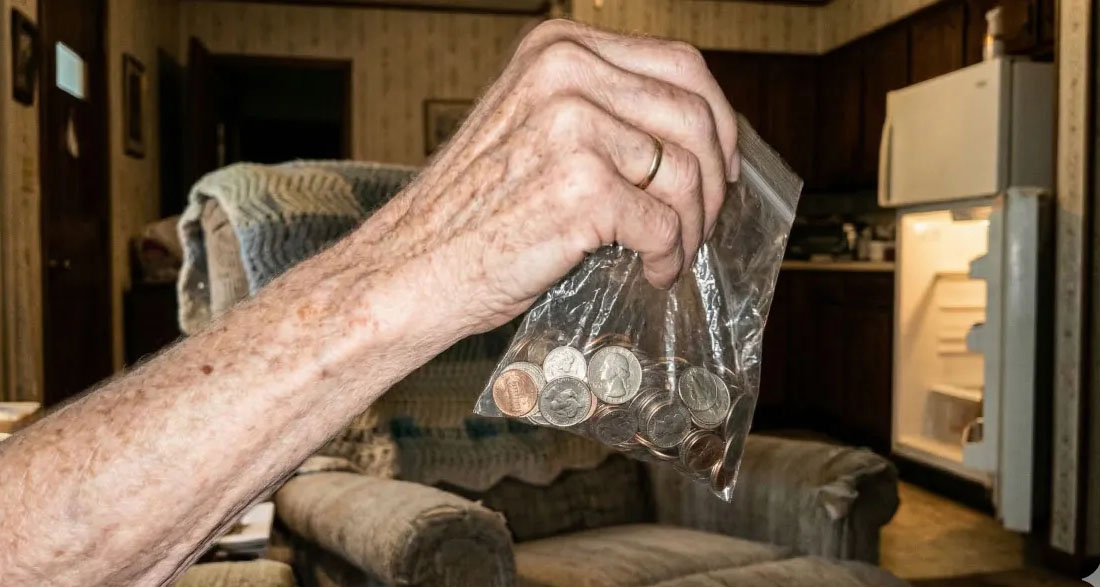
She leaned slightly toward the small side table and pushed a plastic sandwich bag toward me.
“I’m perfectly fine,” she said. “I keep the heat low because medication comes first. It’s the only thing I can’t skip.”
I looked down at the bag. Coins—quarters, dimes, nickels, pennies—a whole life of scraped-together change.
“I think this should cover it,” she said softly. “I counted twice.”
I stared at the coins for a long moment, my heart sinking. Then I glanced at the fridge. Almost nothing inside: a few water bottles and a small pharmacy bag.
That’s when it hit me. This wasn’t a casual order. This pizza wasn’t a treat. It was probably the only hot meal she could get without standing over a stove she didn’t have the strength—or perhaps even the energy—to use.
“Don’t worry about it,” I said, leaning down to push the bag of coins back toward her. “It’s already taken care of.”
Her brow furrowed. “I don’t want you getting in trouble.”
I don’t know why I said it. Maybe it was easier than watching her count pennies into my hand.
“It’s okay, really. I own the place,” I said.
She studied me, then relaxed. Her gaze dropped to my name tag.
“Well,” she said, “thank you, Kyle.”
I nodded and set the pizza on her lap. She opened it, closed her eyes, and inhaled the steam with a smile. Watching her bask in that warmth hit me harder than anything else that night.
I stood there for a second, feeling almost useless. Then I mumbled good night and headed back outside.
I got in my car, shut the door, and just sat there. Across the street, a porch light flicked on. My hands rested on the steering wheel. No lights, no heat, almost no food. Just that woman pretending she was “perfectly fine.”
I picked up my phone and texted dispatch: Flat tire. Need 45 minutes. The first excuse that came to mind. I needed time. I couldn’t leave her like that.
I started the car and drove two blocks to the police station I’d passed on the way here. I never imagined what would happen next.
Inside, the officer behind the desk looked me over and frowned.
“You need something?”
I told him about the older woman in her cold, dark house, how she chose medication over heat, and how alone she was.
“And you think she’s in danger?” he asked.
“I think someone who knows more than me should decide that,” I said. “But yeah. If nobody checks on her, something bad could happen.”
He nodded once, picked up the phone, and called it in. Then he slid a clipboard toward me. “Need your name and number in case they follow up.”
I filled it out, breathing a little easier. I even smiled, convinced I’d done the right thing.
But as I drove past her house on the way back to the shop, that illusion shattered.
An ambulance was parked outside, lights flashing. Neighbors crowded the sidewalk. Two paramedics appeared at the front door, helping her between them. Calm but urgent.
Her eyes found me.
“You!” she pointed, trembling. “This is your fault.”
“I was worried about you,” I said.
“I told you I was fine!”
“You were freezing,” I said softly.
“I was managing!” she snapped, coughing hard. “They’re taking me out of my home because of you.”
One of the neighbors stepped forward. “Hey, what did you do?”
“I got her help,” I said firmly. “She needed it.”
“She’s always been like that,” muttered another neighbor.
“She’s stubborn,” someone else added.
“Then why didn’t you help her?” I demanded, my voice shaking.
No one answered. I got back in my car and drove away, hands trembling on the wheel.
After that night, everything changed. Every dark porch, every elderly person living alone, I paused. I asked questions I wasn’t supposed to ask. And in the back of my head, I kept hearing her voice: This is your fault.
A week later, the consequences of that night caught up to me. I was folding boxes in the back when my manager leaned through the kitchen window.
“Kyle, delivery up. They asked for you.”
I froze. The slip was her address.
I pulled up, porch light on, knocked, and the door opened almost immediately.
A woman I didn’t know, maybe mid-forties, gave me a quick once-over.
“Come inside. Someone wants to speak to you.”
The house was warm, full of life. People moved around, unpacking groceries, plugging in a space heater. I recognized some of them as the neighbors who had shouted at me that night.
And there she was. Same chair, but no mountain of blankets. Two little kids played on the rug, one holding a crooked knitting strip.
“Show me again,” the little girl said. “I keep messing up this loop.”
“Slow hands. Watch,” the woman said, laughing.
I just stood there, pizza in hand, absorbing it all.
One of the men walked over. “Listen… I’m sorry. About that night,” he said, rubbing the back of his neck. “We didn’t realize how bad it had gotten. That’s on us.”
A woman in the kitchen called out, “We all missed it.”
The older woman looked at me, her face lighting up.
“It’s you,” she said. “I’m so glad you came. Come here.”
One of the neighbors took the pizza from me and pressed $20 into my hand.
I stepped closer to her chair. She looked stronger, though not magically fixed.
“I owe you an apology, Kyle,” she said softly. “I was angry. I was scared. At the hospital, they told me what could’ve happened if I’d stayed there longer.”
“But you’re back home now,” she added, reaching for my hand. “Because of you. You were the only one who saw I was in trouble, even when I didn’t want to admit it.”
The woman in the kitchen said, “We made a schedule. Somebody stops by every day.”
“And county services come twice a week now,” said the guy by the heater.
The man who apologized gave a short nod. “We’re making sure she eats and stays warm.”
“We should’ve done it before,” said the woman at the door.
Standing there in that warm room, groceries on the counter, kids on the floor, neighbors finally talking instead of looking away, I understood something I hadn’t before.
Doing the right thing doesn’t always feel good. Sometimes it feels awful. Sometimes people hate you for it. Sometimes it feels like you stole their pride, their privacy, the story they were telling themselves about how bad things really were.
But sometimes, the thing you interrupt is the lie that’s killing them.
Doing the right thing doesn’t always feel good—but it can save a life.