


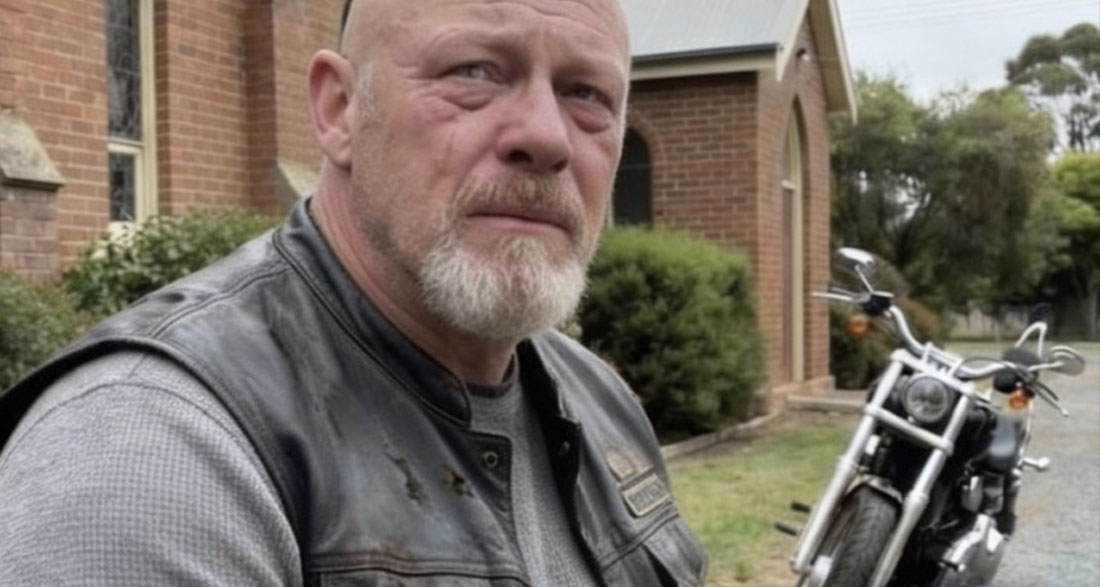
For more than forty years, Michael Thompson had been part of the quiet heartbeat of First Baptist Church.
He was never the loud kind of faithful. He did not lift his hands high during worship or speak long prayers filled with fancy words. He did not try to impress anyone. Instead, he showed his faith in small, steady ways that most people only noticed when they were truly needed.
Mike fixed broken doors when they wouldn’t close right. He painted walls when the church budget was tight and no one else volunteered. He drove elderly members to doctor’s appointments when their families were busy or gone.
He sat beside hospital beds late at night, holding a hand in silence so no one had to be afraid or alone.
When the playground behind the church was built years ago, Mike was there every single weekend. He showed up early with a hammer in his hand and sawdust stuck in his hair. He helped pour the concrete until his arms ached.
He helped bolt the swings into place, tightening each screw twice just to be sure. He planted the little trees around the edges, patting the soil down gently and saying, “These will be good shade someday.”
Now those trees stood tall. Generations of children had laughed, scraped their knees, and played under their branches—on equipment Mike had helped build with his own hands.
That was just who he was.
For the last fifteen years, Mike had done much of this work on the back of his motorcycle.
It was an old Harley. Loud. Heavy. Scratched and worn from years of use. It wasn’t fancy, and Mike never tried to make it look new. He rode it because he loved it, yes—but also because it took him places most church members never went.
The bike carried him into small trailer parks on the edge of town. It took him down long dirt roads to houses that leaned and creaked with age.
It carried him to lonely men and women who had stopped coming to church because walking hurt too much, or because they felt forgotten, or because they believed they no longer belonged.
Mike never preached at them. He never judged them.
He sat with them at their kitchen tables. He listened to their stories. Sometimes he read a psalm out loud. Sometimes he fixed a leaking pipe or changed a light bulb. Sometimes he prayed softly. Sometimes he didn’t say a single word.
But every time, people felt seen when Mike came.
People felt remembered.
For a long time, no one had any problem with that.
Then Pastor Davidson arrived.
He was young, sharp, and well-spoken. He dressed neatly, used modern phrases, and talked often about vision, growth, and image. He had been hired to help the church attract young families and become more “relevant” to the community.
At first, everyone was hopeful.
Mike welcomed him warmly. He shook his hand with a firm grip and said, “If you ever need help with anything, just let me know.”
He offered to fix things, to drive people, to do whatever was needed. He even invited the pastor to ride along one afternoon to visit a man who hadn’t been able to attend church for years.
The pastor smiled politely and said, “I appreciate that, but I’ll pass this time.”
The tension didn’t start loudly.
It started quietly.
A look that stayed a little too long on Mike’s leather vest.
A small pause when Mike mentioned where he had ridden that day.
A polite smile that didn’t quite reach the eyes.
Then one afternoon, after a church picnic, Mike received a call asking him to come in for a talk.
He assumed it was about the broken fence on the side of the building. Or maybe the youth group van that had been making strange noises.
Instead, he was told he would no longer serve as a deacon.
There was no big explanation. Just a gentle voice saying the church was “moving in a new direction.” That his “image” might not match what the church was trying to show the community.
He was also asked—kindly but firmly—to park his motorcycle somewhere out of sight during church events.
“To keep things comfortable,” they said.
Mike sat there quietly and listened.
He did not argue.
He did not raise his voice.
He nodded.
He thanked them.
And then he went home.
That night, Mike sat at his kitchen table for a long time, his hands folded in front of him. The house was quiet. The clock ticked loudly on the wall.
He did not feel angry.
He felt… small.
Not because he lost a title.
But because decades of faithful work had suddenly been reduced to something shameful.
All because of a motorcycle.
He kept coming to church.
Now he sat in the back pews.
He stopped wearing his leather vest.
He parked his bike behind the building, out of sight.
Most people didn’t notice anything had changed.
Until Sarah Williams did.
Sarah had been part of the church almost as long as Mike. She had taught Sunday school when Mike was just a teenager. She had buried her husband in that church. She knew every hallway, every crack in the walls, and every story behind every family.
And she noticed when Mike moved to the back.
She noticed when he stopped helping up front.
She noticed when he stopped smiling.
So she asked.
At first, Mike tried to brush it off. “It’s nothing,” he said. “Just how things are now.”
But Sarah had a way of asking questions that made it impossible to hide the truth.
When she finally heard what had happened, her face went very still.
She said quietly, “Thank you for telling me.”
She hugged him tightly.
And then she said, “Don’t you worry. I’ll take care of this.”
The following Sunday, something unusual happened.
The parking lot began to fill with motorcycles.
One by one.
Then two by two.
Then in small groups.
Men and women wearing leather vests, jeans, boots, and bandanas parked neatly in rows. They didn’t rev their engines. They didn’t make noise. They didn’t show off.
They simply came.
They walked inside quietly.
They filled the pews.
The sanctuary, usually calm and tidy, now held something different.
It held weight.
It held stories.
It held people whose lives Mike had touched.
People who had been prayed for, helped, and listened to.
When it was time for announcements, Sarah stood up.
She didn’t ask permission.
She didn’t raise her voice.
She simply spoke.
“This church needs to hear something today,” she said.
She told the story clearly.
She told it honestly.
She told the church that a man who had served faithfully for forty-three years had been quietly removed because of how he looked and what he rode.
“This man,” she said, “has brought more hurting people into this church than any program we ever paid for.”
She said, “Kindness doesn’t wear one uniform.”
She said, “Faith doesn’t arrive in just one shape.”
And then she said, “If we are ashamed of Mike, then we have forgotten why this church exists.”
The room was silent.
Some people cried.
Some looked down at their hands.
Some looked straight at the pastor.
The church board met that week.
They voted.
They apologized—publicly.
Mike was asked to return as a deacon.
The pastor later asked to visit Mike at his house.
They sat at the same kitchen table where Mike had once sat alone.
The young pastor was nervous. His hands shook slightly.
He said, “When I was a child, my town was hurt badly by a biker gang. That fear stayed with me. I didn’t even realize I was carrying it.”
He added quietly, “I cared more about how things looked than what they really were.”
Mike listened.
Then he smiled.
Then he said, “I forgive you.”
Not loudly.
Not dramatically.
Just simply and fully.
They prayed together.
Later on, Mike taught him how to ride.
Not fast.
Not wild.
Just steady.
Today, the church looks different.
The parking lot holds many kinds of cars.
And many kinds of bikes.
Teenagers come who never came before.
People come who never felt welcome before.
Mike wears his vest again.
And no one asks him to hide it.
The church did not lose its heart.
It found it again.
One mile at a time.