

The road was empty except for me, my bike, and the whisper of wind brushing through the trees. It was just after three in the morning when the old Cedar Creek Bridge came into view—a place that always looked a little eerie in the dark, half-lit by the pale moonlight.
My bike shuddered suddenly, a metallic rattle echoing into the night. My stomach tightened. I knew that sound. Trouble.
I pulled over, muttering curses under my breath as the engine coughed one last time before falling silent. I swung my leg off, kicked the gravel, and reached for my flashlight. That’s when I heard it—soft, almost swallowed by the wind. A faint, broken whimper.
I froze. This wasn’t some stray animal in the distance. This was pain, real and raw. I followed it cautiously around one of the old concrete supports, and that’s when I saw her.
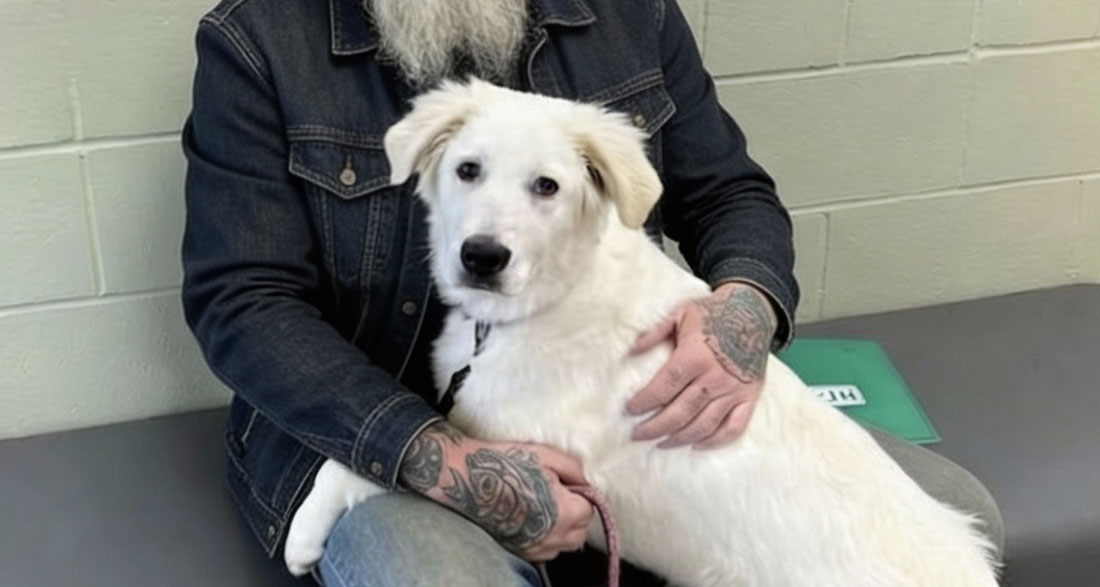
A Golden Retriever, chained to the beam. Her fur was matted, dull, and covered in grime. Her eyes were tired, but still held that gentle, unwavering light dogs always seem to keep no matter what. She was so thin I could see her ribs. Hanging from her belly was a tumor—large, ugly, heavy, like a cruel anchor dragging her down.
Someone had tried to make her comfortable. A threadbare blanket lay under her, a metal bowl with water sat beside it, and next to that, a stuffed yellow duck, worn almost to nothing from love.
There was a note taped to the bridge. The handwriting was steady but human, adult. The words were trembling in places, smudged like they’d been written through tears. “We’re sorry,” it read. “We can’t afford the surgery… or even to put her down. Please, whoever finds her, don’t let her suffer.”
The dog lifted her head when she saw me. Even in her pain, she wagged her tail, slow but sure, like she was trying to tell me she was happy someone had come. That tail—it broke me. It wasn’t the wag of a dog expecting a treat. It was gratitude, and something that felt like goodbye.
I knelt beside her, my hand stroking her head. Her fur was rough, warm despite the chill. That’s when I noticed something tucked into her collar—a folded piece of paper, written in purple crayon. The letters were uneven, crooked, but I could read them under the flashlight:
“My name is Madison. I’m seven. Daisy is my dog. Mommy went to heaven. Daddy said Daisy has to die. But I prayed and prayed because I think angels ride motorcycles. Please help her. I love her. She’s all I got.”
My throat tightened. Inside the collar, taped carefully, was a small bag of coins—quarters, nickels, pennies. $7.43. The note said it was her tooth fairy money.
I just sat there. Fifty-eight years old, grease on my hands, a man who didn’t cry easily anymore—but that night, I cried harder than I had in decades. I had just come from visiting my brother in hospice. Cancer was winning, and there wasn’t a damn thing I could do.
I felt useless, angry, tired of losing. But when Daisy inched closer, dragging her sore body just to rest her head in my lap, something cracked open inside me. I couldn’t save my brother. But maybe I could save her.
I pulled out my phone and called my vet. He was half-asleep when he answered, but when I told him what I’d found, he said, “Bring her in. Now.”
I wrapped Daisy in the blanket, carried her to my bike, and rode slowly through the empty streets, her head resting against my arm. The surgery took hours. It cost more than I should’ve spent, and the vet warned me the cancer had already spread.
But Daisy made it through. When she opened her eyes afterward, groggy but alive, she wagged that same soft wag. It wasn’t victory—it was grace. She was still here.
A week later, I tracked down Madison and her dad. They lived on the edge of town in a small house with peeling paint and a porch swing that creaked in the wind. Her dad looked worn down to the bone—grief, bills, and guilt clinging to him.
He told me about Madison’s mom, who had died in a car accident two years back. “I tried to hold everything together,” he said, voice heavy, “but the medical bills, losing my job… I just couldn’t. I didn’t want Madison to watch her dog suffer. Leaving her by the bridge… it was the only mercy I knew.”
Madison ran out when she saw my bike in the driveway, blonde curls tangled, pajamas covered in stars. She looked at my leather vest, my helmet, and her eyes widened.
“Are you the motorcycle angel?” she asked, voice trembling with hope.
I knelt to her level. “I don’t know about angel,” I said, “but I did find Daisy.”
Her hands flew to her mouth. “You found her?”
“She’s safe,” I said. “She had surgery. She’s tired, but she’s okay.”
When I brought Daisy out of the truck, Madison let out a sound somewhere between a sob and a laugh. Daisy’s tail thumped against the blanket. Madison wrapped her arms around Daisy’s neck and whispered, “I told you the angels would come.”
After that, I started visiting. Sometimes to check on Daisy, sometimes just to help fix a leaky faucet or mow the yard. Madison would sit on the porch steps drawing pictures of Daisy and me on my bike, always adding wings to my back. She said that’s how she saw me.
Daisy’s strength returned slowly. She still had cancer, and the vet warned she wouldn’t live forever. But dogs don’t count time the way we do. They live, and love, in the moments they have left. Daisy played in the yard, chased a ball, and slept with her head on Madison’s pillow. She was loved—and for her, that was enough.
I noticed changes in Madison’s dad too. He smiled more, stopped drinking as much. He told me once, “Seeing Daisy wag her tail again… it made me think maybe I can survive losing her mom.”
When Daisy’s time finally came, it was quiet and peaceful. Madison held her, whispering how much she loved her. Daisy went with that same calm wag, like she was saying thank you one last time.
We buried her under the big oak in their backyard, the stuffed duck tucked beside her. Madison placed her $7.43 on the grave. “It’s Daisy’s money now,” she said, despite my protests.
But it wasn’t the end. Madison and her dad started volunteering at a local rescue.
She came up with a project called “Daisy’s Angels,” where kids could donate spare change to help sick or abandoned dogs. It grew fast—first jars in stores, then classrooms, then the news. Within a year, Daisy’s Angels had paid for dozens of dogs’ medical care. Madison said, “It’s what Daisy would’ve wanted.”
Every visit, she runs up with a new drawing or story about a dog they’ve helped. On my wall hangs her first drawing—me on my bike with wings, Daisy behind me wearing a tiny helmet. Next to it, the original crayon note and the $7.43, framed.
Sometimes I think about that night—the quiet bridge, the broken sound that made me stop. And then I think about everything that followed. The laughter. The healing. The belief that kindness still matters.
I’m not a man of faith. Not really. But that night taught me something about what angels might look like. They don’t always have halos. Sometimes they ride motorcycles, crying over a sick dog at three in the morning. Sometimes they’re seven, writing letters in crayon to the sky.
And sometimes, all it takes to prove there’s still good in the world is stopping when you hear someone crying in the dark. Because you never know what small act might change a life—yours, or someone else’s.
Now, whenever I cross Cedar Creek Bridge, I slow down. The air there feels different, softer somehow.
I imagine Daisy’s tail wagging in the wind, Madison’s voice laughing in the distance, and I whisper a quiet thank you—to the dog who reminded me what compassion really means, and to the little girl who believed angels might come roaring out of the night on two wheels.
Because she was right. Sometimes, angels really do ride motorcycles.