


Officer Matt Kade had been awake for hours—too many hours. His eyes stung, his muscles ached, and every breath of the frigid winter air felt like ice cutting straight through him.
Ten hours into a night shift that already felt like twenty, he was running on nothing but stale coffee, stubbornness, and the quiet promise that he could go home as soon as the sun dared to peek over the horizon.
The roads outside town were empty, silent under heavy layers of snow, and even the heater in his patrol car groaned as if it, too, wished it could vanish into warmth somewhere else.
He wasn’t thinking about anything—just letting the monotony hum—when the radio crackled to life.
“Aggressive dog on Old Quarry Road. Possibly dangerous. Caller didn’t stick around.”
Matt groaned and rubbed his tired eyes. Just what he needed. Aggressive dogs were always unpredictable, and cold nights made them worse. But duty was duty. He flicked on the lights and started the slow crawl toward the old, winding road by the quarry—a place so forgotten even the snow seemed reluctant to settle there.
The closer he got, the stranger it felt. The wind died down. The trees hung still. Even the quiet hum of his tires over icy pavement softened. It was the kind of silence that made you feel like you’d stepped into someone else’s world.
Then he saw it—a thin, ghostly shape huddled in the snowbank at the side of the road.
He braced himself—but nothing could have prepared him for what he saw.
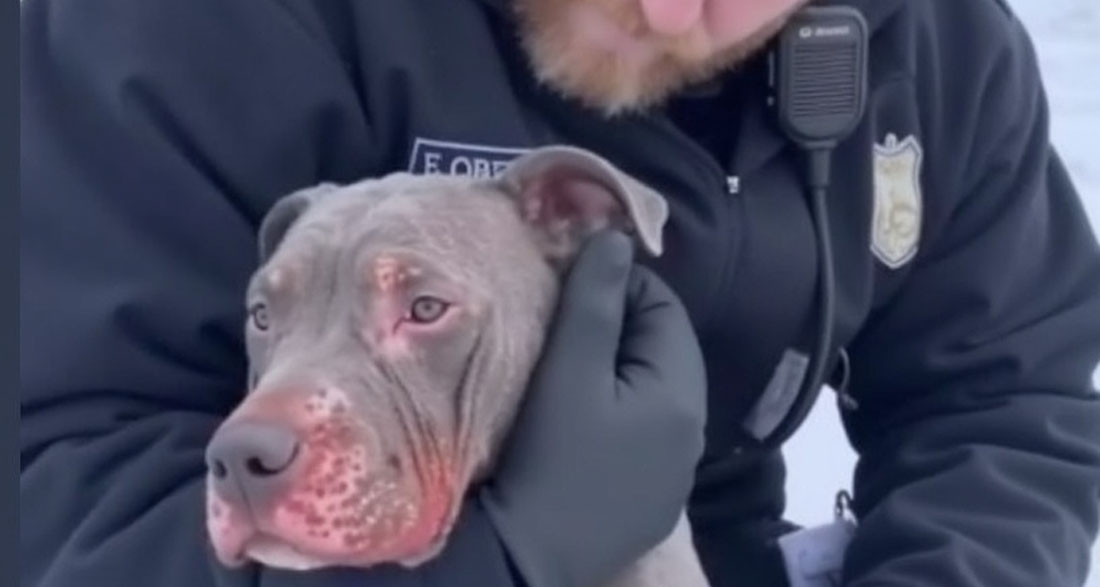
The dog was skeletal, the kind of thin that makes your stomach hurt to look at. Ribs jutted sharply, hips were painfully prominent. Around his neck hung a cruel spiked collar, heavy and far too big, the kind of thing that made fear look like power.
Half of the fur on his face was gone, eaten away by frostbite. His skin was cracked, raw, frozen in patches. Snow clung to his eyelashes. And he didn’t move—not when the patrol car door opened, not when boots crunched across the frozen earth, not even when a human stopped a few feet away.
No growl. No bark.
Just trembling.
And those eyes. Wide, sunken, haunted. Eyes that looked like they had carried every lonely night the world had to offer. They lifted for a moment, meeting Matt’s, then dropped again, heavy with a weight that seemed almost unbearable.
Matt froze. He’d faced aggressive animals before. But this wasn’t aggression. This was… brokenness. The dog’s soul had been chipped away, piece by piece, by hands that should have been gentle.
Protocol screamed at him to stay back, call animal control, wait. But that gaze pulled him in. It reached past the rules, past training, past caution. Something human stirred in him, something softer, older, instinctive.
He lowered himself slowly into the snow.
It was freezing, but he didn’t care. He didn’t reach out. He didn’t tower. He just sat.
“Hey, buddy…” His voice was soft, almost fragile. “I’m here now. You’re okay.”
The sound drifted into the stillness, like a thread thrown into darkness. Slowly, the dog turned his head toward it. Not fully, not boldly—just a tiny, trembling shift, like he was trying to remember what kindness felt like.
Minutes passed. Ten long, fragile minutes, each stretching like an eternity. One shivering, one waiting. Neither moved.
Then, a slight forward shift. No lunge. No threat. A surrender. A question. A plea.
Matt’s chest tightened, then opened. He inched closer, careful, gentle, like he had done with children hiding from the world. The dog stayed still. Watching. Wide-eyed. Vulnerable. Waiting.
Finally, Matt reached out, brushing his fingers against the brittle, cold fur. The dog made a soft, strange sound—half sigh, half whimper. Relief mixed with fear.
“It’s okay,” Matt whispered. “I’ve got you.”
He slipped off his coat and wrapped it around the fragile creature. The dog weighed almost nothing. Just skin, bones, and a fluttering pulse. When Matt lifted him, he didn’t fight. He melted into the warmth, his frostbitten head resting heavily on Matt’s chest.
Nothing else mattered. Not procedure. Not rules. Just this. A survivor finally finding a hand to hold.
Matt carried him to the patrol car, refusing to let the snow touch him again. Inside, the heater blared, pushing the cold away. The dog curled in the coat, slowly letting his breathing even out. For the first time in months, maybe years, he slept. Not exhausted sleep, but safe sleep.
At the vet, the list of injuries was long. Starvation. Frostbite. Deep bruises from the spiked collar. Scars that whispered horrible stories. But there was no aggression. Only flinching, hesitation, the quiet hope that maybe—just maybe—someone could be kind.
Matt didn’t leave his side. Technically, he had other calls, other responsibilities. But he couldn’t go. Not when the dog lifted his head each time, checking if the man from the snow was still there.
Days passed. The dog slowly gained strength. He ate cautiously, curled up tightly, and flinched at sudden sounds. But every time Matt visited—twice a day—his eyes brightened a little more. Recognition grew in them. Recognition and trust.
When the dog was ready to leave the clinic, he needed a foster. Matt didn’t hesitate.
“I’ll take him,” he said quietly. No heroics. No speech. Just simple truth.
The dog had already chosen him.
The first night in Matt’s home was quiet. The dog paced, sniffed, flinched at creaks—but eventually, he settled at Matt’s feet, head on his boot. Matt didn’t move. Not yet. Trust was fragile.
He named him Quarry. After the road where they met. A fitting name for something abandoned that was being rebuilt.
Bit by bit, Quarry changed. Tail wags grew stronger, bolder. He learned hands could warm, voices could soothe, and the world could be soft.
One night, while Matt dozed on the couch, Quarry nudged his head under Matt’s arm. Matt curled around him instinctively. Quarry sighed, deep and content—the kind of sigh that comes from finally feeling safe.
Months passed. The dog who had once been half-buried in snow became full of life, playful, trusting. His fur grew thick and soft. Frostbite scars remained, but no longer defined him—they reminded him of survival, resilience, and second chances.
When winter returned, and snow blanketed the streets, Matt would sometimes catch Quarry staring out the window, lost in memory. But the moment Matt called his name, Quarry would turn, tail wagging, eyes shining. Because he was home. Because darkness no longer had power.
People often said Matt saved Quarry that night.
He always shook his head.
“Quarry saved himself,” he’d say softly. “I just sat long enough for him to believe someone cared.”
And something inside Matt had shifted, too. He walked onto that road expecting danger. What he found was life, fragile but waiting. Rescue didn’t always look like lights and sirens. Sometimes it was a tired officer, sitting in snow, whispering soft words into darkness.
Healing didn’t always start with medicine or rules. Sometimes it began the moment a broken soul dared to lean toward hope.
Quarry leaned.
Matt stayed.
And on that frozen winter road, where the world seemed dead, something new finally had space to grow.