

I thought adopting my late best friend’s four children was the hardest thing I’d ever do. But I was wrong.
Years later, a stranger appeared at my door and changed everything. She told me my friend “wasn’t who she said she was,” then handed me a letter. The lies Rachel had carried through her life now threatened the life we’d built without her.
Rachel had been my best friend for as long as I could remember.
There was never a single moment when we became friends. We just always were.
We sat next to each other in elementary school because our last names were close in the alphabet. In high school, we shared clothes—sometimes secretly, sometimes not. In college, we shared cramped apartments and endless stories about the worst boyfriends we ever had.
By the time we had children, our friendship had grown into something more than just shared memories. We shared calendars, carpool schedules, and late-night parenting advice.
“This is it,” Rachel said one day, standing in my kitchen with a baby on her hip and another tugging at her leg. Her eyes were bright with a mix of exhaustion and wonder. “This is the part they don’t tell you about.”
“The noise?” I asked, smirking.
She laughed, shaking her head. “No—the love. How it just keeps multiplying.”
I had two kids. She had four. She was constantly tired, yet she glowed in a way that felt real. Rachel loved being a mom more than anything—or at least, that’s what I believed.
Twenty years of friendship make you think you know someone. You think transparency is part of the deal. But looking back now, I realize how many secrets Rachel carried—secrets I never saw.
Everything changed after Rachel gave birth to her fourth child, a tiny girl she named Rebecca. Her pregnancy had been difficult, and she’d spent the last half on strict bed rest.
Barely a month after they brought Becca home, tragedy struck. Rachel’s husband was in a car accident.
I was folding laundry when my phone rang.
“I need you,” Rachel’s voice said, breaking in half.
“I need you to come now.”
When I arrived at the hospital, Rachel sat in a plastic chair, clutching the baby carrier between her knees. Tears streaked her cheeks, her face pale and hollow.
“He’s gone,” she whispered. “Just like that.”
I didn’t know what to say, so I just held her. Let her cry. Let her grief fill the room.
The funeral was a gray, rainy Saturday. Rain pounded the cemetery while Rachel stood with her children clinging to her, little arms wrapped around her legs.
“I don’t know how to do this alone,” she whispered after, her voice trembling.
“You won’t be alone. I’m right here,” I said, trying to steady my own heart.
But life wasn’t done testing her. Not long after, cancer was diagnosed.
“I don’t have time for this,” she said bitterly when she told me. “I just got through one nightmare.”
She tried to be brave for the kids. She joked about wigs, insisted on school drop-offs when she could barely stand. I started going over every morning.
“Rest. I’ve got them,” I told her.
“You already have your own,” she protested weakly.
“So? They’re all just kids.”
During those months, Rachel often looked at me like she wanted to say something, to reveal some hidden truth. She would open her mouth, pause, frown, and stare off into the distance.
Once, she said, “You’re the best friend I’ve ever had. You know that, right?”
“You’re mine too,” I whispered.
“I’m not sure I am… a good friend, that is.”
At the time, I thought she was just guilty because I was helping her so much. I know now that I was wrong.
Six months later, she was dying.
“I need you to listen,” she whispered.
“I’m here,” I said.
“Promise me you’ll take my kids, please. There’s nobody else. I don’t want them to be split up. They’ve already lost so much…”
“I’ll take them. I’ll treat them like my own,” I promised.
“You’re the only one I trust,” she said, her voice thin and frail. Those words pressed into me like a stone.
“Rebecca… keep a close eye on her, okay?”
I thought she was just worried about the baby, still fragile and tiny. Little did I know, those words would haunt me later.
When the time came, keeping my promise to Rachel was easier than I expected.
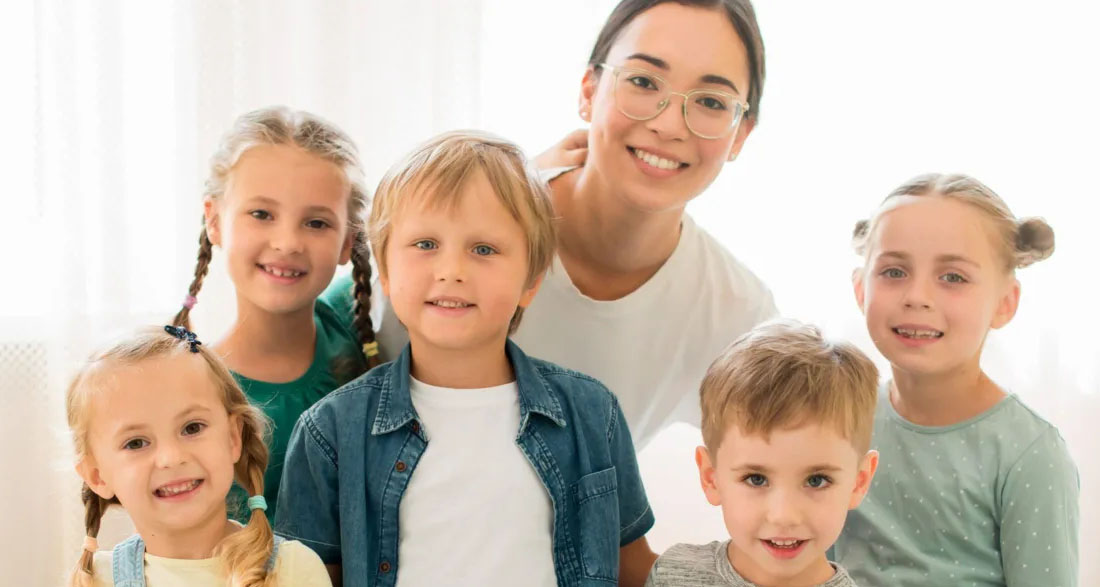
She and her husband didn’t have relatives willing to step in. My husband didn’t even hesitate. Overnight, our family grew—suddenly, we were parents to six children. The house was smaller, louder, messier—but also fuller than I had ever imagined.
Over weeks and months, they grew close, bonded like siblings. My husband and I loved them all like our own. Life slowly became steady again. For the first time in years, I believed we had made it.
But one afternoon, that calm was shattered. There was a knock at the door.
A woman stood on our porch, well-dressed, sharp, maybe five years younger than me. Her hair was pulled back tight, and her gray coat looked expensive. But her eyes—red-rimmed and raw—told the story of someone who had cried recently.
“You’re Rachel’s friend,” she said. “The one who adopted her four children?”
I nodded, my skin prickling.
“I know we don’t know each other, but I knew Rachel. And I need to tell you the truth. I’ve been looking for you for a long time.”
“What truth?” I asked, uneasy.
She handed me an envelope. “She wasn’t who she claimed to be. You need to read this letter.”
I took the envelope, frozen, half-opening the door. Rachel’s handwriting was unmistakable. As I read, it felt like I was forgetting to breathe.
The letter told me everything:
“I’ve rewritten this more times than I can count,” Rachel wrote. “I don’t know which version you’ll hear. I remember exactly what we agreed to.
You came to me when you were pregnant and barely holding yourself together. You told me you loved your baby, but feared what would happen if you tried to raise her. When I offered to adopt her, it wasn’t because I wanted to take something from you.
It was because I thought I could hold things steady until you could breathe again. We decided to keep it private. You didn’t want questions. I didn’t want explanations. I told people I was pregnant because it felt easier than telling the truth. And because I believed it protected all of us.”
My fingers tightened on the paper. One of Rachel’s children wasn’t hers? And I never knew?
The woman on my porch pressed, “So she wasn’t pregnant?”
“No. Not with my girl. And now you know the truth—it’s time to give her back,” she said.
I instinctively stepped sideways, blocking the door.
“Rachel adopted her. I adopted her. That doesn’t vanish just because you want it to.”
“It’s what she promised me!” The woman’s voice shook. “It’s all there in this letter!”
I forced myself to keep reading, though my heart hammered.
“I told you once we’d talk again when things were better. All I can ask is that you think first about her, not what was lost.”
“I turned my life around! I can take care of her now, I swear!” The woman’s lip quivered.
“She deserves to be with me, her family!”
I looked at the children upstairs. Every room, every corner, carefully built over years. “She lied to me,” I said.
“Yes,” the woman admitted. “She lied to everyone.”
“But she didn’t steal your child. There’s nothing in this letter that gives her back to you.”
“Her blood is mine,” the woman whispered, pleading.
“She has her brothers, sisters, her room full of things. Blood doesn’t make a family—you do. And I have the papers to prove it.”
The woman shook her head, desperate, almost begging. “You can’t do this to me! You were supposed to understand…”
“I do. I understand what Rachel did, and I understand what you’re asking. But the answer is no.”
Finally, she lunged, snatched the letter, and turned away.
“I’ll be back,” she warned. “Next time, you won’t stop me from claiming what’s mine.”
I closed the door, forehead pressed against it, my body shaking with exhaustion and fury. Rachel had lied. She had kept a secret that could have torn apart our family. But now, we were stronger. I would protect my children.
A year later, the courts confirmed what I already knew: adoptions can’t be undone just because someone changes their mind. Becca was mine. And all my children—six in total—were safe.
I walked down the courthouse steps that day feeling a calm I hadn’t known in years. Our family was protected, whole, and no one could take that from us.
We had survived lies, death, and secrets—and come out stronger. Our family wasn’t perfect. But it was ours.