

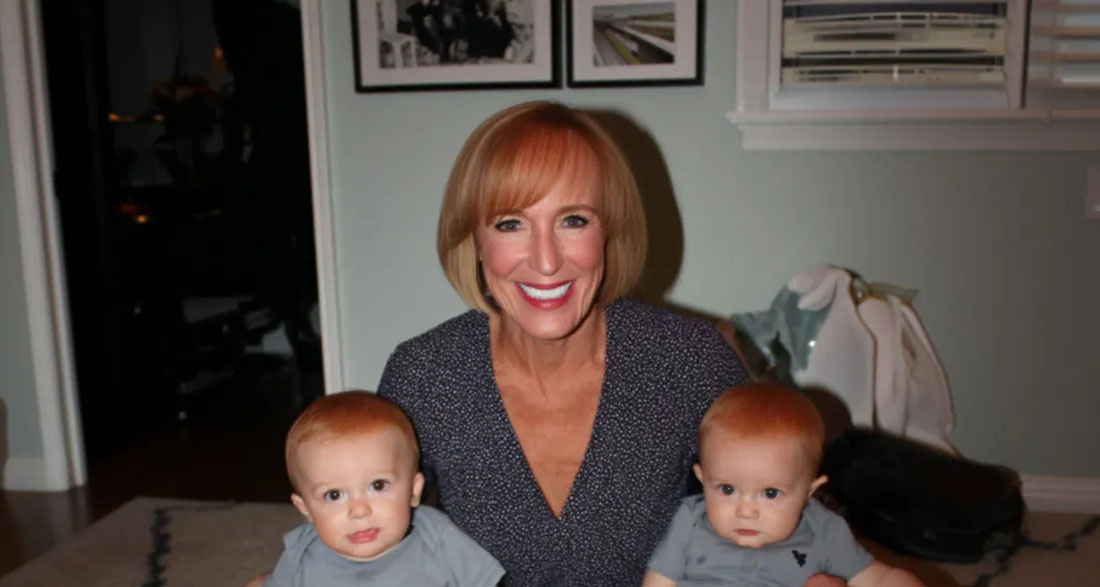
I used to think the hardest part of raising twins was the exhaustion.
I was wrong.
The real shock came the evening I opened the nanny cam app and saw something that made my blood run cold.
I have 11-month-old twin boys, Liam and Noah. If you’ve never had twins, imagine being so tired that sleep deprivation becomes part of your personality. For almost a year, I hadn’t slept more than three hours in a row.
Not once. My body felt like it was running on fumes. My brain felt foggy. Some days, I couldn’t even remember what day of the week it was.
Mark, my husband, traveled for work at least twice a month. Sometimes more.
When he was gone, it was just me and the boys in our quiet house. No grandparents to call. No siblings to drop by. My parents had passed away years ago, and I was their only child. Mark grew up in foster care, moving from one home to another. We had no safety net. No backup plan.
It was just us.
Two weeks before everything fell apart, I broke down on the kitchen floor.
Liam was screaming from the playpen. Noah was banging a spoon against his high chair tray, over and over and over again. The noise felt like it was drilling into my skull.
“I can’t keep doing this,” I sobbed into the phone when Mark called that night. “I’m so tired I can’t even think straight anymore.”
On the other end of the line, his voice softened immediately.
“You shouldn’t have to do this alone,” he said. “I should’ve hired help months ago.”
We decided to hire a nanny—but only through a licensed agency. I wouldn’t have trusted anything less. They ran background checks. They verified references. They confirmed CPR certification. I checked everything myself. I read every document twice.
If something went wrong, it wouldn’t be because I hadn’t done enough.
They sent us Mrs. Higgins.
She looked to be around 60. She walked through our front door wearing a soft blue cardigan, sensible flats, and a warm smile. Her gray hair was twisted neatly into a bun. She smelled like lavender and sugar cookies. She carried herself with calm confidence, like someone who had raised children who respected her.
“Oh, my little darlings,” she said the moment she saw Liam and Noah.
Her voice was tender, but steady.
To my complete shock, my boys—who normally screamed at strangers—crawled straight into her lap.
I stared at Mark. He stared back at me.
“Well,” he whispered, almost amazed, “that feels like a good sign.”
It felt like more than a good sign. It felt like oxygen after nearly drowning.
Within days, she knew the rhythm of our house better than I did. She warmed bottles without asking. She folded laundry so perfectly it looked ironed. She even reorganized our linen closet exactly how Mark liked it, with fitted sheets tucked into matching pillowcases.
The boys adored her. She sang to them in a soft, gentle voice. She rocked them to sleep like she had done it a thousand times before.
For the first time in months, it felt like God had finally remembered me.
Then one evening, Mark surprised me.
“I booked us a spa overnight,” he said, holding out his phone like he was offering me a miracle. “Just one night. No monitors. No interruptions.”
I burst into tears before I could stop myself.
Mrs. Higgins insisted we go.
“You both look exhausted,” she said gently, squeezing my hand. “You deserve rest. The boys will be perfectly fine. I promise.”
Still, something inside me wouldn’t fully relax.
The morning we left, I secretly installed a nanny camera in the living room. I didn’t tell Mark. I didn’t tell her.
I told myself it was just for peace of mind. But the truth? Ever since becoming a mother, I trusted nothing completely.
At 8:45 p.m., Mark and I were sitting in plush white robes in the spa lounge. Soft music played in the background. For the first time in nearly a year, my shoulders weren’t up around my ears.
But I couldn’t stop myself.
I opened the nanny cam app.
The boys were asleep in their crib in the living room. Mrs. Higgins was sitting on the couch.
She wasn’t knitting. She wasn’t watching TV.
She was just… sitting there.
Then she slowly turned her head and looked around the room.
A cold feeling crept up my spine.
She reached up and lifted off her gray hair.
It came off in one piece.
It was a wig.
My heart slammed against my ribs so hard I thought I might faint.
Underneath the wig was short, dark hair.
“Oh my God,” I whispered.
Mark grabbed the phone from my hand. His face drained of color.
“What is this?” he demanded.
“I don’t know,” I said, my voice shaking.
On the screen, we watched as she pulled a wipe from her pocket and began scrubbing her face. The wrinkles smeared away. The age spots vanished. Even the small mole near her cheek disappeared.
She wasn’t 60.
She looked closer to her late 40s. Maybe early 50s.
Then she stood and walked toward the window.
My stomach dropped.
She reached behind the curtain and pulled out a large duffel bag.
“What is this?” Mark muttered again, his voice tight.
She unzipped it and carried it toward the crib.
“We’re leaving,” I said, already standing. “My babies are in danger.”
Mark didn’t argue. We threw on our clothes and ran. My hands shook as I refreshed the video feed again and again during the drive home.
My mind raced through every possible horror—kidnapping, ransom, revenge.
But when she reached into the bag, she didn’t pull out anything dangerous.
She pulled out small, neatly wrapped packages.
Hand-knit blue sweaters with the boys’ names embroidered on the front.
Two stuffed elephants.
Then she took out a camera.
She set it up carefully near the crib and whispered, “Just one picture for Nana.”
Nana.
The word echoed in my head.
I turned slowly to Mark.
“Do you know her?” I asked.
He kept his eyes on the road.
“Mark,” I pressed, my voice trembling. “You know her, don’t you?”
His jaw tightened.
“She’s my mother,” he said finally.
The world tilted.
“You told me she was a monster.”
“I told you we didn’t have a relationship.”
“You said she wasn’t safe.”
“I said she wasn’t part of my life,” he snapped. “That’s not the same thing.”
We pulled into the driveway. I jumped out before the car fully stopped.
Inside, the house was peaceful.
She was sitting calmly on the couch, holding Noah against her chest. Liam was asleep in the crib.
She looked up when we burst in.
“Mark,” she said softly.
“Mom, don’t,” he replied immediately.
I stepped forward.
“Start explaining.”
She gently placed Noah in the crib.
“My name is Margaret,” she said. “I work for the agency under the name Mrs. Higgins because families warm up to it more. But I wore the wig and makeup because I knew Mark would recognize me. And I knew he wouldn’t let me near the children.”
“You lied to us,” I said.
“Yes,” she answered calmly. “I did.”
“Why?”
Her eyes glistened. “Because I wanted to see Mark. And my grandchildren.”
Mark let out a bitter laugh. “You don’t get to play grandmother.”
“I never stopped being your mother,” she said quietly.
“You lost that right.”
“I lost custody,” she corrected gently. “There’s a difference.”
“What happened?” I asked firmly. “Because clearly I don’t know the whole story.”
“It doesn’t matter,” Mark said sharply.
“It matters to me,” I replied.
Margaret folded her hands. “His father didn’t want him. I had no money. No support. The court didn’t listen.”
“You failed,” Mark shot back.
“I was young and alone,” she said, her voice steady but trembling at the edges. “But I never stopped loving you.”
Then she added softly, “I’ve been sending money every month since the twins were born. I wanted to help.”
Suddenly, the anonymous envelopes we’d received over the past year made sense.
“You knew,” I said slowly to Mark.
Silence.
“Mark.”
“Yes.”
“I only wanted to talk,” Margaret said quietly.
“Leave!” Mark shouted.
The boys stirred.
She picked up her duffel bag.
“I never meant to frighten you,” she said gently to me. “I just didn’t know how else to reach him.”
Then she walked out.
The next morning, after Mark left for work, I called the agency.
“Margaret?” the coordinator said. “Yes, she’s been with us six years. Excellent record. Families request her by name.”
“Has there ever been a complaint?” I asked.
“No, ma’am. She’s one of our most trusted caregivers.”
That didn’t match the picture Mark had painted.
I found her number in the paperwork and called her.
We met at a nearby restaurant. I brought the twins.
“Thank you for reaching out,” she said softly.
“I need to hear your side,” I told her.
She sighed.
“His father abandoned us. Someone called Social Services. They took Mark. I wasn’t allowed visits without supervision. There were court dates. Lawyers. I sold my car. I worked two jobs. I slept on a friend’s couch to pay legal fees. In the end, the judge said stability mattered more than love. I had the latter.”
“Mark said you didn’t fight.”
Her eyes filled with tears.
“I fought until I had nothing left,” she said. “When he turned 18, I called. He answered once and said, ‘Stop pretending you care.’ Then he hung up.”
That sounded exactly like Mark.
“I’ve been sending money because it’s the only thing he’ll accept,” she continued.
“You disguised yourself.”
“I didn’t want to scare you,” she said quickly. “But when I saw how exhausted you were, you reminded me of myself back then. I couldn’t walk away.”
She never blamed him. Not once.
That night, after the boys were asleep, I told Mark, “I met her.”
He froze. “You what?”
“You went behind my back first,” I said evenly. “You took her money and hid her from me.”
He stopped pacing.
“You’re angry,” I said gently. “You have every right to be. But maybe she didn’t stop fighting. Maybe she just didn’t win.”
His voice cracked. “You don’t know what it felt like to wait for her to choose me.”
“And maybe she did,” I whispered. “Maybe the court chose differently.”
He closed his eyes.
“I don’t know how to forgive her,” he admitted.
“You don’t have to forgive everything,” I said. “Just start with a conversation.”
Two days later, he agreed to meet her at a coffee shop.
I stayed in the car with the boys.
Through the window, I watched them sit across from each other. Tension filled the space between them.
Then something shifted.
His shoulders dropped, just slightly.
When he returned to the car, his eyes were red.
“She said she would’ve chosen me every time,” he said quietly. “That she never stopped fighting.”
“And?”
He swallowed. “I think I needed to hear that.”
The following Sunday, Margaret came over—no wig, no disguise.
“I won’t push,” she said softly at the door. “I only want whatever you’re comfortable giving.”
Mark hesitated.
Then he stepped aside.
“You can come in,” he said.
As she held the boys, she whispered, “Hello, my little darlings.”
Mark watched her carefully.
After a moment, he said quietly, “They’re lucky to have you.”
She looked at him as if he had handed her the entire world.
And for the first time since that terrifying night at the spa, something settled inside me.
Not perfection.
Not a fairytale ending.
But the beginning of something honest.