


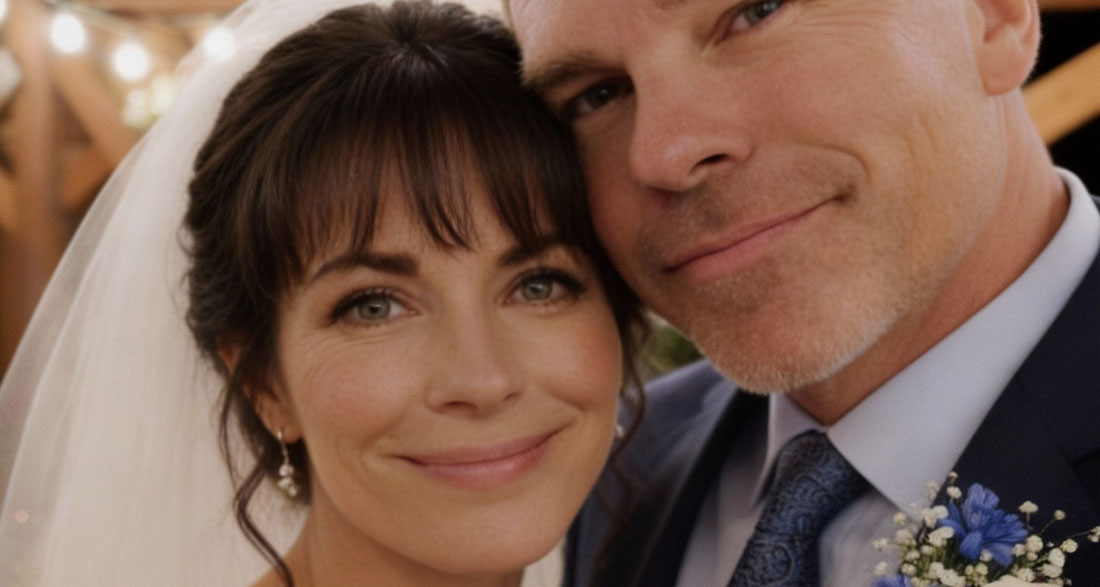
When Daniel asked me to marry him, I truly believed I had already survived the worst pain life could give me. I had buried my husband, learned how to raise our children mostly on my own, and somehow figured out how to wake up each day without falling apart. I thought I understood grief. I thought I had paid my dues.
So when Daniel knelt in front of me and asked me to be his wife, I said yes with a full heart, believing the darkest days were finally behind me.
I had no idea that on our wedding night, standing in front of an old metal safe, Daniel would whisper words that would shake everything I thought I knew about loyalty, love, and second chances.
I’m forty-one years old now, and there are still mornings when I open my eyes and lie very still, trying to understand how this became my life.
For twenty years, I was Peter’s wife.
Not in a movie-perfect way. Not with constant romance or dramatic gestures. But in the real way — the kind built from ordinary days that slowly turn into something precious.
We lived in a four-bedroom colonial house with a porch that was always half fixed and floors that creaked loudly at night like old knees. We raised two kids there. Kids who left toys everywhere, slammed doors when they were angry, laughed too loudly, and filled the house with noise and life.
Now my daughter is twenty-one, studying in college as far east as she could go. My son is nineteen, studying engineering all the way out west. They grew up and flew in opposite directions, and I couldn’t be prouder.
But the house feels wrong now.
Too quiet. Too still. Like the walls are waiting for voices that will never come back.
Silence has weight. I didn’t know that before.
Peter used to smile and call our life “ordinary,” like it was the greatest compliment in the world. To him, ordinary meant steady.
Safe. Reliable. He believed in fixing everything himself, even when he had no idea what he was doing. I’d tease him about it, rolling my eyes, while secretly watching the way he concentrated so hard, his brow furrowed like the problem mattered more than anything else.
He wasn’t perfect. He was stubborn. He left messes. He sometimes went quiet when I needed him to talk. But he was mine. And he made me feel safe in ways I didn’t fully understand until the day that safety disappeared forever.
Six years ago, a drunk driver ran a red light.
Peter was just driving home from work.
A police officer knocked on my door that night. The moment I saw his face, I knew. My legs gave out. I remember collapsing on the porch, screaming into the cold air, feeling like my entire world split open.
Everything after that feels blurry, like watching someone else’s life fall apart.
My daughter cried behind a locked bathroom door. My son punched holes in the garage wall and refused to talk to anyone.
I woke up night after night at two in the morning, wandered into the kitchen, and stared at Peter’s coffee mug still sitting by the sink. I couldn’t bring myself to move it. Touching it felt like admitting he was really gone.
Everything hurt. Breathing hurt.
And then there was Dan.
Daniel had been Peter’s best friend since childhood. They grew up three houses apart, inseparable.
They shared terrible ideas, endless jokes, and memories I’ll never fully know. At twenty-two, they drove across the country together, sleeping in their car and surviving on gas station food. They weren’t just friends. They were brothers.
Dan had already lived through his own pain — a failed marriage, a bitter custody battle, a daughter he loved deeply but didn’t see enough. He never complained. Never blamed anyone. I always admired that about him, even before everything fell apart.
When Peter died, Dan didn’t ask what I needed.
He just showed up.
He fixed the garbage disposal Peter had been meaning to repair. He brought groceries when I forgot to shop. He sat with my son in the garage for hours, handing him tools while my boy broke old wood apart with all the anger he didn’t know how to release.
One night, while Dan was changing a lightbulb, I finally said, “You don’t have to keep doing this.”
He didn’t even look down from the ladder.
“I know,” he said quietly. “But Pete would’ve done it for me.”
That was it. No speeches. No expectations. Just loyalty.
Healing doesn’t announce itself. It happens quietly, in small moments you don’t notice at first.
Three years after Peter’s death, my kids were finding their footing again. I was learning how to be something other than the widow. Dan gave me space, stepped back when he sensed I needed it.
Then one night, around eleven, my kitchen sink started leaking.
Without thinking, I called him.
He arrived twenty minutes later in sweatpants and an old college T-shirt, toolbox in hand.
“You know,” he said, kneeling under the sink, “you could’ve turned off the water and called a plumber tomorrow.”
“I could’ve,” I said, leaning against the counter. “But you’re cheaper.”
He laughed — a real laugh. And for the first time in months, I laughed too. Something small but important shifted between us.
After that, things became easy. Coffee on Sunday mornings. Movies on Friday nights. Long talks that lasted until the moon disappeared. He never pushed. Never flirted. Never made me feel like I owed him anything.
But something was there.
My daughter noticed before I did.
“Mom,” she said one afternoon, “you know Dan’s in love with you, right?”
I almost choked on my coffee. “No. We’re just friends.”
She rolled her eyes. “Mom. Come on.”
It took weeks to admit the truth to myself. The guilt felt heavy. How could I love someone else when Peter was gone? But grief doesn’t end. It changes shape.
Dan waited.
One evening on the porch, as the sun sank low and the air smelled like summer rain, he finally spoke.
“I need to tell you something,” he said. “You can tell me to leave and never come back. But I can’t keep pretending.”
My heart raced.
“I’m in love with you, Isabel,” he whispered. “I know it’s wrong. He was my best friend.”
“It’s not wrong,” I said softly. “I feel it too.”
His eyes filled with tears. “I can’t be another loss for you.”
“I’m sure,” I told him.
And just like that, the truth set us free.
We were careful. Quiet. We told the kids first.
My son shook Dan’s hand and said, “Dad would want you to be happy, Mom.”
My daughter cried and hugged us both.
When I told Peter’s mother, I expected anger. Instead, she smiled sadly.
“You’re with Daniel,” she said gently. “Peter loved you both. You’re not betraying him. You’re living.”
Dan proposed in my kitchen.
“I can’t promise perfect,” he said. “But I promise to love you.”
“That’s all I need.”
Our wedding was simple. Warm. Fairy lights, borrowed chairs, laughter. Dan’s vows made me cry.
“I promise to honor the man who brought us together,” he said.
That night, everything felt right.
Until it didn’t.
When I came out of the bathroom, Dan stood in front of the safe, shaking.
“There’s something you need to read,” he said.
Inside was an old phone.
Messages between him and Peter.
A promise.
Fear filled his eyes. “Did I take advantage of your grief?”
I held his face and said, “No. You kept your promise. You loved me when I needed it most.”
We cried. We forgave. We chose truth.
Now, two months later, I wake up with peace — not easy peace, but earned peace.
Grief and love live together.
I’ve been a wife and a widow. I’ve lost and loved again.
Life is messy.
But sometimes, the mess is where the beauty hides.
Because real love isn’t about starting over.
It’s about continuing on.
And somehow, we did.