

Three weeks after my mother died, I finally did the thing I had avoided since the day we buried her.
I broke open the thrift‑store locket she had kept glued shut for fifteen years.
I didn’t even finish reading her note before I called the police.
Because whatever she had hidden inside that locket suddenly felt heavier than grief. Heavier than loss. It felt like something meant to change lives.
My mother, Nancy, lived quietly.
She was the kind of woman who never bought anything new if she could help it. She reused tea bags until they barely had color. She clipped expired coupons and still tried to use them. In winter, she wore thick sweaters and fuzzy socks instead of turning on the heat.
She baked bread from scratch, kneading dough with steady hands. She scrubbed floors with vinegar instead of fancy cleaners. When our winter coats split at the seams, she didn’t replace them — she patched them.
My mother lived quietly.
She never splurged on herself. Not once. Except for one thing.
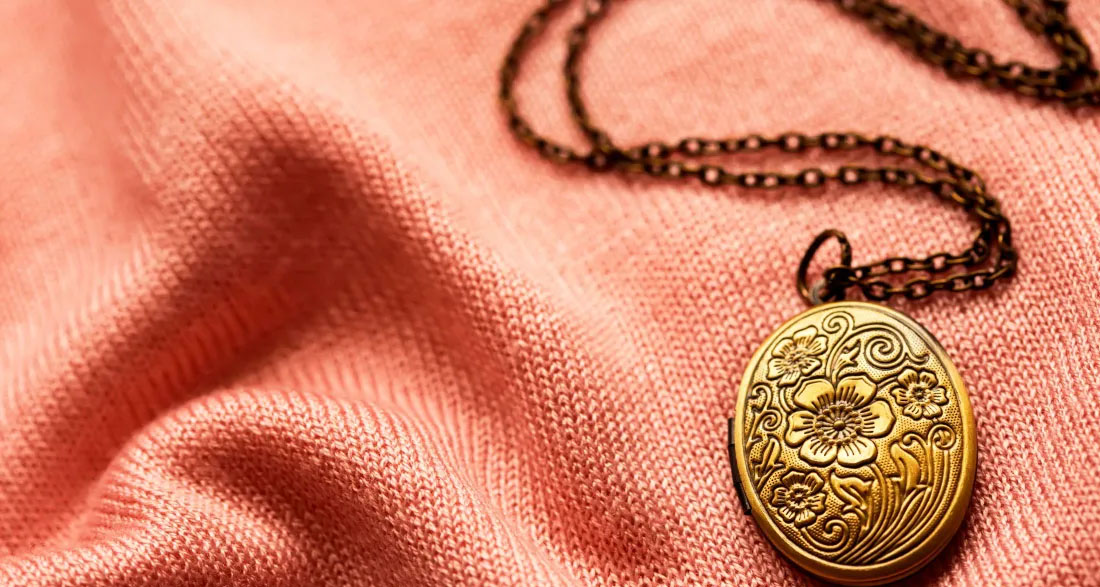
A cheap, gold‑plated heart locket she found at Goodwill almost fifteen years ago.
It wasn’t real gold. The shine had faded to a dull, brassy yellow. But she wore it every single day. Around the house. To the grocery store. Even to bed.
She wore it in hospice.
Almost every photo I have of her shows that little heart resting against her collarbone.
I asked her once what was inside.
She smiled, like it was the silliest question in the world.
“The latch broke the week I got it, Natalie,” she said gently. “I glued it shut so it wouldn’t snag on my sweaters.”
“But what’s inside?” I pressed.
She reached out and touched my cheek.
“Nothing, sweetheart. Absolutely… nothing.”
I believed her.
Why wouldn’t I?
“Nothing, sweetheart. Absolutely… nothing.”
—
My daughter, Ruby, is six.
She was born with severe conductive hearing loss. She isn’t completely deaf, but close enough that the world reaches her like it’s underwater. Sounds come muted, distorted, distant.
She wears tiny hearing aids that help with certain tones, but she still depends on lip‑reading, facial expressions, vibrations, and instinct to understand what’s happening around her.
It has made her sharper than most adults I know.
Ruby notices everything.
My daughter and my mother were inseparable. My mom taught her how to bake bread, letting her feel the dough change beneath her hands.
She showed her how to plant sunflowers from seed, pressing them into the dirt together. She taught her how to feel music by placing her palm against a speaker and closing her eyes.
When my mom passed, Ruby stood close to me, gripping my arm.
“I didn’t hear Gran leave,” she whispered. “Did she leave already?”
That moment shattered me.
“I didn’t hear Gran leave. Did she leave already?”
A few days later, we were packing up my mom’s house. We went through kitchen drawers, closets, old jars filled with buttons and bent nails.
That’s when Ruby held up the locket by its chain.
“Grandma said this would be mine one day.”
“I know, baby,” I said softly, taking it from her. “Let me clean it up first, okay? I’ll make it nice and shiny for you.”
She nodded and smiled.
“I’ll make it nice and shiny for you.”
Then she added, casually, “She used to tap it twice. Right before she left the house. I saw her do it lots of times.”
I froze.
Because that was true.
For years, my mother had tapped the locket twice before stepping outside. Tap‑tap. I always thought it was just a nervous habit.
But suddenly, it didn’t feel like that at all.
Tap‑tap. Like a signal. Like a promise.
I walked toward the kitchen, and my hands slipped. The locket fell and hit the hardwood floor.
It didn’t sound like metal on wood.
It rattled.
Not a hollow clink — but a muffled rattle, like something small was trapped inside.
“What on earth?” I whispered. “Mom… what have you been hiding from us?”
That night, after Ruby fell asleep, I sat at my mother’s kitchen counter. The room smelled like acetone and lemon dish soap. I had a razor blade, paper towels, and shaking hands.
The glue wasn’t sloppy. It was clean. Precise.
This wasn’t convenience.
This was intentional.
“Please be a picture,” I whispered. “Please be a photo of me as a kid. Or your first love. Please don’t be something that makes me question everything…”
It took hours.
Then — snap.
The locket opened.
A tiny microSD card slipped out and rolled across the counter.
Behind it was a folded note, written in my mother’s careful handwriting.
“If you find this, it means I’m gone, Natty. Be careful. It’s a great responsibility.”
My stomach dropped.
My mother didn’t own a computer. She hated smartphones. She barely trusted the microwave.
So what was this?
My mind spiraled. Illegal data? Stolen information? Something dangerous?
I thought of Ruby asleep down the hall.
I didn’t hesitate.
I called the police.
—
The first officer arrived the next morning. He looked at the card on the table and raised an eyebrow.
“Ma’am… a memory card isn’t exactly a crime scene.”
“Then why would she glue it shut for fifteen years?” I snapped. “Why would she write ‘be careful’?”
“Maybe she liked puzzles,” he shrugged. “Maybe it’s a recipe.”
I almost told him to leave.
Then another woman stepped forward — Detective Vasquez. Calm. Sharp. Grounded.
She examined the locket and the note.
“You did the right thing calling,” she said gently. “Not because it’s dangerous. But because it may be valuable. Would you like us to look into it?”
I nodded.
Later that week, I found the Goodwill receipt.
“September 12, 2010. Gold‑plated heart locket. $1.99.”
I also found Ruby’s insurance denial letter.
Her surgery wasn’t covered.
“Elective,” they said.
“So hearing my voice is a luxury?” I snapped into the phone. “Put a supervisor on.”
“I want the criteria in writing,” I said firmly.
“We can reopen the claim,” they finally admitted. “With documentation.”
“Good,” I said.
That same day, Detective Vasquez called.
“It’s Bitcoin,” she explained. “Early. Very early.”
The number on the screen made my hands go numb.
Then came the note.
“He said it would change my life,” my mother had written. “I didn’t know what it was. But I knew it wasn’t for me. Natalie, this is yours.”
She wrote about a man named Emmett. Homeless. Hungry. She fed him pie and coffee.
“He handed me the card in a napkin,” she wrote. “And said it would matter one day.”
I stood in her living room and turned on the heat.
And cried.
She went without comfort — but left my daughter a future.
“You knew, Mama,” I whispered.
I called the hospital.
Ruby’s surgery was scheduled.
—
The night before, I placed the locket around Ruby’s neck.
“Does it still rattle?” she asked.
“Not anymore.”
“Do you think Grandma will know I wore it?”
“I think she’d be proud.”
At the hospital, the audiologist smiled.
“Just listen.”
Ruby’s eyes filled with wonder.
“Your voice, Mommy,” she whispered. “It sounds like it’s hugging me.”
I laughed. I cried.
We fixed the roof. Bought books with sound. Music boxes she could feel.
Ruby taps the locket twice now, every time she leaves.
Tap‑tap.
A promise kept.
My daughter hears the world now.
And because of my mother’s quiet kindness, Ruby will never miss a thing — especially my voice, telling her how deeply she is loved.