

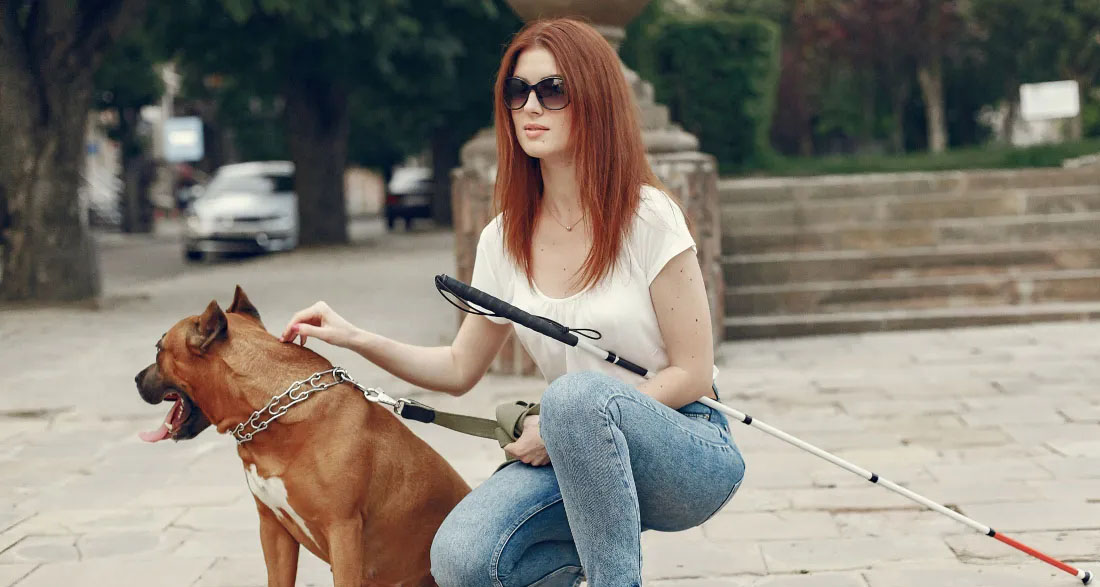
I spent twenty years imagining what my husband looked like. I pictured his smile, the way his hair fell across his forehead, the shape of his hands. I even imagined his voice. But the day I finally saw his face, the truth hit me like a thunderclap: our entire life together had been built on a lie.
I lost my sight when I was eight.
It started with a stupid playground joke, one that spun completely out of control.
I remember the swings at our old neighborhood park. I pumped my legs as high as I could, soaring through the air because I loved that flying feeling. I was laughing at something my neighbor’s son said. We’d grown up on the same street, spent countless afternoons together, sharing secrets and dares.
“Bet you can’t go higher than that!” he teased, his voice full of challenge.
“Watch me!” I shot back, grinning.
Then everything changed.
A sharp shove from behind knocked me off balance. My small hands slipped from the chains, and instead of flying forward, I fell backward. There was a sickening crack as my head hit a jagged rock near the mulch border.
I don’t remember the ambulance ride.
I remember waking up in a hospital bed, my mother’s quiet sobs filling the room. Doctors whispered words that cut through the haze: optic nerve damage… severe trauma… One surgery. Then another. But it wasn’t enough.
The darkness swallowed me.
At first, I thought it was temporary. I’d wave my hands in front of my eyes, waiting to see a flicker. Nothing came. Weeks stretched into months. Eventually, I accepted the truth: my sight was gone.
I hated the dark. I hated depending on people. I hated hearing my classmates run past me in hallways while I traced lockers with my fingertips.
But I refused to shut down. I forced myself to live in darkness.
I learned Braille. I memorized rooms by counting steps. I trained my ears to pick up the smallest shifts in someone’s breathing. I adapted. I thrived. I refused to let blindness define me.
I finished high school with honors. I got into university. And every year, I visited specialists, clinging to a single fragile hope: that maybe, one day, I would see again.
Then, when I was twenty-four, he appeared.
His name was Nigel, a new ophthalmic surgeon at the clinic. The first time he spoke, his voice struck a chord deep in my memory. I tilted my head toward him, trying to place the sound.
“Do we know each other?” I asked.
He hesitated, then answered, “No. I don’t believe we do.” There was a pause, almost too long, and yet… something unsettled me.
Still, he was kind. Patient. Gentle. When he explained my condition, he did so clearly, without pity. When he spoke of experimental procedures, it was with quiet determination, not vanity.
Over the next year, he became my primary doctor. Then he became my friend. He’d walk me to the parking lot, describing the sky.
“It’s one of those clear, sharp blue days,” he said once.
I laughed. “That sounds lovely.”
Eventually, he asked me to dinner.
“I know this crosses a line,” he admitted, his voice careful, “but I’d regret it for the rest of my life if I didn’t ask. Would you go out with me?”
I should have hesitated. Doctors dating patients was complicated. But something about him felt… right. I said yes.
Dating him was easy. He let me cook, even when I burned things. He memorized the way I took my coffee, placing the mug exactly three inches from my right hand. Two years later, we were married.
The night before our wedding, I traced his face with my fingertips.
“You have a strong jaw,” I said softly.
“Is that good?” he asked.
“I think so. You feel steady.”
He kissed my palm. “I am.”
Life unfolded in quiet rhythm. We welcomed two children, Ethan and Rose. I learned their faces through touch. My husband thrived in his career, specializing in complex optic nerve reconstruction. Late nights became normal. I’d wake at two a.m., reaching across the bed, finding only emptiness.
“Stay in bed,” I’d mumble when he returned.
“I’m close,” he whispered. “I’m so close to something big.”
I believed him. I thought it was for a patient.
Then, after twenty years, he told me the truth.
“Babe, I finally figured out how to do it,” he said one evening, his voice trembling. “Our dream is going to come true. You’ll see again. Trust me.”
I sat at the kitchen table, frozen, my heart pounding.
“Don’t play with me,” I whispered.
“I’d never do that,” he replied, kneeling before me. “I’ve been developing a procedure to reconnect damaged pathways using a regenerative graft. It’s risky, but you’re a viable candidate. And… I would perform it myself.”
I swallowed hard. Fear clawed at me. What if it failed? What if I woke to the same darkness—or worse, a world I could no longer navigate?
But I trusted him.
The surgery was scheduled three months later. The weeks crawled. I felt his trembling hands on the night before the operation.
“Are you afraid?” I asked as we lay in bed.
“Yes,” he admitted. “But not of the surgery.”
“Then of what?”
“Of losing you.”
I didn’t understand, but I let it go.
Morning came. Nurses guided me to the operating room. Nigel squeezed my hand.
“You still have time to back out,” he said softly.
“I won’t,” I replied. “If this works, I want you to be the first thing I see.”
His breath caught. He kissed my forehead. “I love you.”
“I love you too.”
Anesthesia swept me away.
When I woke, my head heavy, my eyes bandaged, I called softly, “Nigel?”
“I’m here,” he said immediately. But there was no joy in his voice.
He began unwrapping the bandages. “Don’t hate me. Before you see, I need to tell you… everything isn’t the way you think.”
I laughed nervously. “What does that mean?”
Light pierced my eyelids. White. Gold. Shapes sharpened. Colors flooded in. I could see.
And then… him.
Older than I imagined. Dark hair streaked with silver. Brown eyes rimmed with exhaustion. A thin scar above his left eyebrow.
My chest froze. That scar. The memory slammed into me: the swing, the shove, the fall, the rock.
I clapped my hands to my mouth. “How… How is it possible that it’s you? Why didn’t you tell me?”
“Let me explain,” he said, voice trembling.
I shook my head. “Don’t call me that. You pushed me. You’re the reason I lost my sight!”
“I was eight,” he whispered. “I didn’t mean for you to fall.”
“But you did!” I shouted. “Then you disappeared. And now… you let me marry you without telling me?”
The nurse stepped closer. “Ma’am, please stay calm.”
“I want to leave. Now!” I said, pulling away as they guided me into a wheelchair.
Nigel followed. “Please… just hear me out.”
“I can’t,” I said. Outside, the sky stretched wide and blue. And it felt cruel.
Back at home, the world was overwhelming. Colors, shapes, everything foreign. I paused at a wedding photo. Me, smiling, eyes closed, touching his face. Him, looking at me like I was his entire world.
I opened his office drawers with shaking hands. Medical journals, surgical sketches, notes—dates from before we’d even met. My name on a folder, nearly fifteen years old.
I called my best friend, Lydia.
“You won’t believe this,” I said.
“What happened?”
“I can see. The surgery worked. But… it was Nigel. He’s the boy who pushed me. He knew the whole time. I feel betrayed. I can’t trust him.”
There was silence. Then she asked, “Has he ever treated you badly?”
“No.”
“Has he been a good father?”
“Yes.”
“Then maybe you need to listen to him.”
I stared at the evidence. I remembered his voice at the hospital. His guilt. His devotion. “He’s been working on fixing my eyes for more than two decades.”
Nigel entered the room. “I didn’t follow you to pressure you. I just needed to know you were safe.”
“You hid your true identity from me,” I said.
“I know,” he admitted. “I recognized you the first day. I’ve carried that guilt all these years. Becoming an ophthalmic surgeon… it was because of you. I searched for you.”
“Then why hide it?”
“I was ashamed,” he said. “And… I fell in love with you. I was terrified you’d refuse me and the surgery if you knew.”
I stared at him. Exhaustion, fear, hope—etched on his face.
“You took my sight,” I said. “But you spent your life trying to give it back.”
Tears filled his eyes. “Every single day.”
My anger didn’t vanish, but it shifted. I chose to trust. To forgive. To finally see him… and love him.
For the first time in years, I saw my husband clearly. And this time, I chose him in the light.