

I’m sixty-four, divorced, and the kind of woman who keeps her calendar so full there’s no room left for silence.
If there’s an empty square on the page, I fill it. If there’s a quiet afternoon, I schedule something useful. My daughter, Melissa, laughs and calls it “productive denial.” She says it lightly, but her eyes search my face when she says it, like she’s checking for cracks.
My son, Jordan, doesn’t joke about it. He just watches me the way you watch the sky before a storm. Careful. Alert. Waiting.
I volunteer because it keeps my hands busy and gives my heart somewhere safe to land. Food drives. Coat collections. Church suppers. School raffles. Anything that lets me fold, sort, stir, carry. Helping strangers feels safer than sitting still with my own memories.
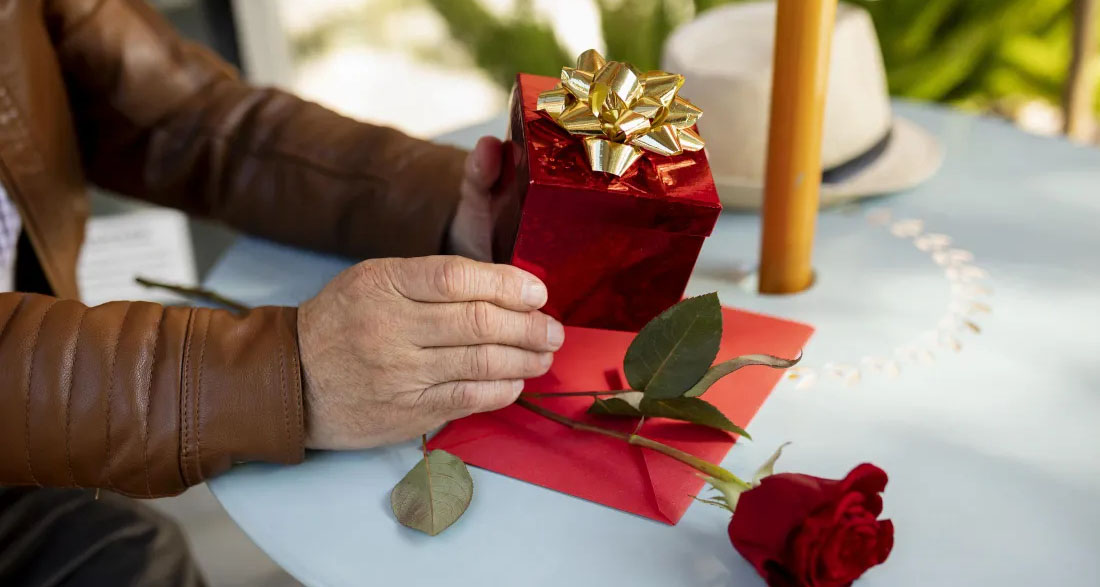
Valentine’s Day was coming, and Cedar Grove needed volunteers to write cards for residents who didn’t get any.
The activity room buzzed with soft chatter and the steady scratch of pens against cardstock. Paper hearts were scattered across the tables like fallen red and pink leaves. The coffee smelled burnt in that familiar community-center way that always reminds me of fundraisers and folding chairs.
Marla, the coordinator, stood at the front with her clipboard tucked against her chest. She wore her hair in a tidy bun and carried an exhausted smile like it was part of her uniform.
She handed each of us a stack of blank cards and a printed list of residents’ full names.
“So the envelopes go to the right doors,” she said, tapping her clipboard with her pen. “Some folks here don’t get visitors.” She paused, her voice softening. “Your words might be their only Valentine.”
I nodded and took my seat.
I wasn’t looking for anything special. I wasn’t searching for nostalgia. I scanned the list the way you scan ingredients on a label, hoping nothing would upset your stomach.
Then my eyes stopped.
Richard.
Same surname.
Same middle initial.
Everything inside me tightened so fast it felt like a fist closing around my ribs.
My pen froze midair.
“It’s a coincidence,” I told myself silently. Richard is a common name. People share names all the time.
But my fingers started to shake—the same way they used to before finals in college or before first dates when I was young and hopeful and terrified all at once.
Forty-six years ago, Richard had been my first love.
And he had disappeared without a goodbye.
Apparently, the past doesn’t stay buried just because you beg it to.
Back then, I was nineteen. I wore too much cheap perfume and believed certainty was the same thing as destiny. I worked afternoons at my aunt’s salon, sweeping hair and listening to women talk about marriages like they were both prisons and lifelines.
Richard was gentle in a way that made other boys uncomfortable. He carried his own books—and sometimes other kids’ books too—and still got teased for it. He never fought back. He just smiled that steady smile and kept walking.
We spent late summer nights on his porch swing, the air heavy with crickets and the smell of cut grass. We planned a future neither of us could afford.
“I’ll get a scholarship,” he told me once, pushing the swing lightly with his foot. “I’ll study hard. We’ll figure the rest out.”
“We?” I teased.
“Always we,” he said.
The night before he was supposed to leave town for college, he swore he’d meet me at the Maple Street diner.
“I wouldn’t miss it,” he promised.
I waited in a red vinyl booth until the waitress stopped refilling my coffee. She gave me a look halfway between pity and impatience.
“You want anything else, honey?” she asked.
I shook my head.
When I called his house from the payphone, his mother answered.
“He’s not here,” she said sharply.
“Do you know when he’ll—”
The line went dead.
That silence followed me home. It followed me into the next morning. It followed me into the weeks after.
Then I found out I was pregnant.
The clinic had peeling posters on the walls and a nurse who wouldn’t quite meet my eyes. The fluorescent lights hummed overhead.
“You’re about eight weeks,” she said quietly.
Eight weeks.
I didn’t tell my parents at first. I didn’t tell Richard because I couldn’t reach him, and after the days stretched into months, pride welded my mouth shut. I told myself if he wanted to find me, he would have.
Life didn’t pause to ask if I was ready.
I married later—not because I forgot Richard, but because I needed stability. Because I had a baby who deserved more than uncertainty. My marriage gave me Melissa. Then Jordan. And eventually it gave me a divorce that felt like both relief and failure tangled together.
Now, decades later, I sat in Cedar Grove with a stack of blank cards and a name that made my pulse throb in my ears.
I forced my hand to move.
Wishing you a happy day. You matter.
Warmly, Claire.
Safe. Neutral. Nothing that revealed the tremor in my chest.
I could have slipped the envelope into Marla’s basket and walked away.
Instead, I heard myself say, “Could I deliver this one?”
Marla looked at me for a long second, as if she sensed something beneath the request.
“Check in with the nurses,” she said finally.
At the station, a nurse named Kim glanced at the envelope.
“He usually sits by the window in the afternoons,” she said gently.
My legs carried me forward before my courage could disappear.
The common area was bright with winter sunlight. A television murmured. A spoon clinked against ceramic. A walker clicked against the tile.
I scanned faces.
Then his eyes met mine.
Richard’s hair had thinned to gray, but his eyes were the same steady blue. For a moment, he stared at me like I was a ghost.
“Richard,” I said.
His mouth formed my name slowly. “Claire?”
He tried to stand. He wobbled, pride holding off the aide who moved instinctively to help him.
I stepped closer because my body remembered him before my mind could object.
Kim appeared beside us. “Would you like some privacy?” she asked softly.
We moved to the small library. Dust and old paper mixed with the sharp scent of lemon cleaner.
I handed him the envelope.
He opened it carefully. His lips trembled as he read the simple words.
When he looked up, tears filled his eyes.
“I never get mail,” he admitted.
The honesty of that broke something open inside me.
“Why did you disappear?” I asked.
His face crumpled.
“My father,” he said. “He trapped me. Took my car keys. Sent me to my uncle’s out of state. He said you’d ruin my future.” His voice shook. “He warned me away from you.”
“And you listened?” I asked quietly.
“I was nineteen,” he whispered. “I was scared.”
He told me he’d heard later that I’d gotten married.
“I thought you’d moved on,” he said. “I thought it was too late.”
I left that day, but my mind didn’t.
In my car, my hands stayed on the steering wheel long after the engine started. I didn’t call Melissa. I didn’t call Jordan. I didn’t call Elaine, even though her name sat in my contacts like a lifeline.
I drove home. I made tea. I stared at the walls. I let the diner booth and the dead phone line and the clinic lights replay in my head.
By midnight, I understood something I had avoided for decades.
Richard’s absence had shaped me.
But it did not get to narrate me anymore.
If I wanted closure, I would take it. In daylight. With someone beside me.
In the morning, I called Jordan.
He arrived within the hour, hair still damp, eyes sharp.
“What’s going on?” he asked.
“I saw Richard,” I said.
His jaw tightened.
“What do you need from me?” he asked.
Practical. Steady.
“I want you with me when I go back.”
He didn’t hesitate. “Then I’m coming.”
We sat in the Cedar Grove parking lot, the heater humming, the sky dull and gray.
“Mom,” he said gently, “what’s the plan?”
I stared at the front doors and finally said the sentence I had swallowed for thirty-nine years.
“When Richard left… I was pregnant.”
Jordan went very still.
Then he covered my hand with his.
“Okay,” he said softly.
No accusation. No anger.
“Okay. Let’s do it your way.”
Inside, Kim recognized me immediately. Her eyes flicked to Jordan and back, as if she understood the shape of the day.
“He’s in the common area,” she said quietly.
Richard looked up when we approached. Relief crossed his face—until he saw Jordan.
“Richard,” I said. “This is my son.”
Jordan extended his hand.
Richard shook it weakly, respectfully. His eyes darted between us, counting years.
“How old are you?” he asked.
“Thirty-nine,” Jordan answered.
Richard’s face drained of color.
“You left,” I said calmly. “And I was pregnant.”
His mouth opened and closed.
“No,” he whispered—not denial, but disbelief.
I nodded.
Jordan stood beside me, silent and solid.
“I didn’t know,” Richard said, his voice breaking. “Claire, I didn’t know.”
He began to cry—quiet at first, then uncontrollably.
When he could speak, he told us doctors had warned him when he was young that children were extremely unlikely for him. His first marriage had ended under that strain.
“I built my whole life around the idea that I couldn’t be a father,” he said, staring at Jordan. “I thought it wasn’t possible.”
“My mom raised me,” Jordan said evenly. “She did it alone.”
Richard nodded, devastated.
We moved to the library again.
“I’m not here for speeches,” I told him when he started apologizing in circles. “I’m here for truth.”
He admitted he’d heard I’d married and decided I was better off without him.
“You decided for me,” I said.
“Yes,” he whispered.
The silence that followed wasn’t empty.
It was earned.
Then I surprised myself.
“Come with us,” I said.
Richard looked stunned.
“Not forever,” I added quickly. “Not as romance. Just dinner. Just conversation outside these walls.”
Jordan glanced at me, questioning, but he stayed quiet.
“I’ll do anything,” Richard said.
“Then here are the terms,” I replied. “No more disappearing. No more secrets. No rewriting the past to make yourself comfortable.”
“Yes,” he whispered. “I swear.”
Kim helped with the paperwork. Richard refused the wheelchair.
In the lobby, Marla watched us without speaking.
Outside, the cold air hit sharp and clean.
Richard paused at the threshold like a man stepping into a world he thought was closed to him.
He looked at Jordan. Then at me.
“Claire,” he said, voice trembling, “I won’t disappear again.”
I held his gaze.
“We’ll see,” I said.
The words weren’t cruel.
They were a boundary.
And for the first time in my life, the next step belonged entirely to me.