


I had lived next door to Harold Peterson for so long that it felt strange to remember a time when he wasn’t part of my life. When I first moved in, he was a tall, strong man, shoulders broad like he could carry the weight of the world.
His hands always smelled faintly of wood and oil. He was a carpenter then—the kind who didn’t just build things, he understood them. He ran his fingers over a piece of wood, nodded like it had told him a secret, and cut it with care, as if the board was alive.
Over the years, I watched Harold change, slowly, quietly. His hair shifted from brown to gray to nearly white. His stride slowed, then became careful, then shaky. One day a cane appeared at his side, then a walker, and finally a wheelchair he never wanted but could no longer avoid.
Margaret, his wife, faded even faster. She had always been smaller, gentler, with a laugh that carried across the yard on summer evenings. When she died, the house became hollow, like sound didn’t want to stay there anymore.
Harold’s children came less and less. At first, it was every few weeks. Then months. Then only on holidays. And eventually, sometimes not even then. They always had reasons. Work. School. Long drives. Colds. Something else more important, always.
The porch told the story more than anything else. Harold had built it himself years ago—wide steps, sturdy railings, solid and reliable. But nothing lasts forever, especially when the person who built it can’t maintain it anymore.
The boards rotted. A step sagged. The railing loosened, then broke. When Harold got the wheelchair, someone had nailed together a rough ramp—just enough for him to get in and out—but it looked haphazard, made from scraps with jagged edges.
I worried every time I saw him use it. The ramp bent under him. One board creaked so loudly I flinched, sure it would give way. I offered help more than once, but Harold waved me off with a tired smile.
“I don’t want to be a bother,” he said, voice low, but I could see the worry behind his eyes.
Then the letter came.
I saw it in his hand when he returned from the mailbox. His shoulders slumped, his face pale. He didn’t speak that day. The next morning, he was on the porch, staring at the letter like it was a strange, foreign thing.
“They say my porch and ramp are unsafe,” he told me quietly, finally breaking the silence. “If I don’t fix them, the city could condemn the house… maybe even force me out.”
I watched him pick up the phone and call his children. I didn’t hear the conversation, but I saw the effect on him. He came back outside, sitting on the porch, shoulders heavy.
“They said it’s not worth fixing,” he whispered. “Just be careful, they said. The house will probably be sold after I’m gone anyway. One of them even said… it might be better if the city stepped in. ‘Simplify things,’ that’s what they said.”
I could see how much it hurt. It wasn’t just the porch—it was being told, gently, politely, that his safety didn’t matter. That he didn’t matter.
That night, I noticed his lights on late. I looked out and saw him inside, holding a framed photo of Margaret. His shoulders shook. He wiped his eyes with the back of his hand, embarrassed to cry even when no one was watching.
I didn’t plan what I did next. I just knew something had to be done.
A few blocks away was a motorcycle club everyone whispered about. Loud bikes. Leather jackets. Tattoos. People crossed the street to avoid them. I’d never gone near them, honestly a little scared of them.
That night, I walked there anyway.
It was quieter than I expected. A few bikes outside, light spilling from the windows. I hesitated, then went in.
All eyes turned to me. Big, rough faces—but curious, not angry. I told them about Harold. A veteran. A man who’d helped neighbors all his life. A carpenter who’d built half the houses on our street. I told them about the letter, the unsafe porch, the children who wouldn’t help.
One of them, a man I guessed was the leader, leaned forward. When I mentioned Harold’s name, his expression changed.
“Harold Peterson… he helped my dad when he lost the use of his legs,” the man said. “Built a ramp, fixed the house. Barely charged him anything.”
I nodded. “Yes. That’s him.”
The room went quiet. Slowly, he nodded. “He did that when no one else would. I never forgot it. Let’s go.”
And that was it.
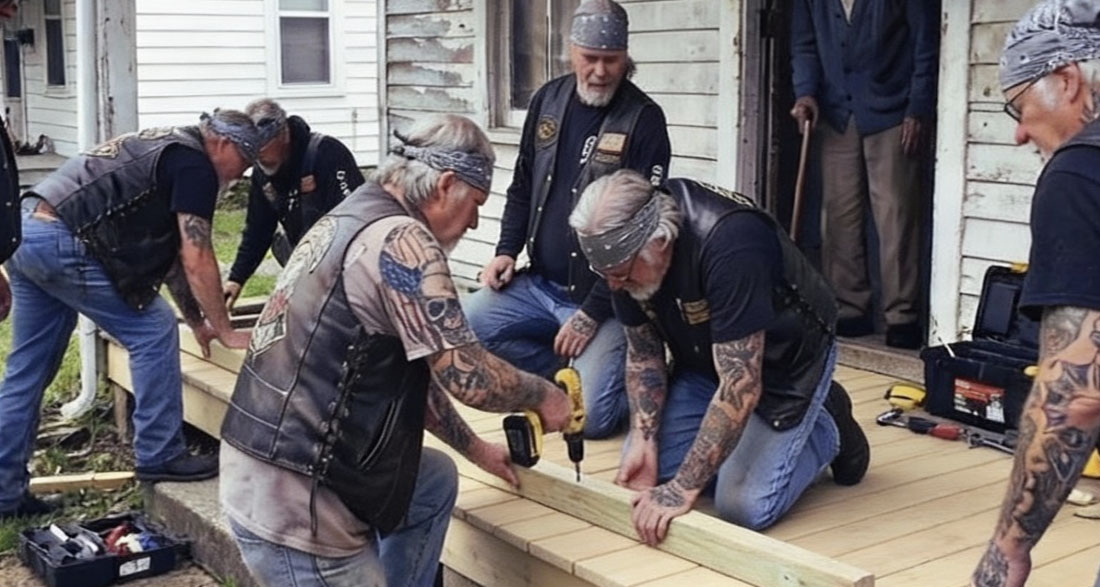
Within an hour, trucks showed up at Harold’s house. Men carried lumber, tools, and lights. No shouting. No music. Just steady work.
Harold was confused at first. “There must be some mistake. I can’t pay you. I don’t deserve this.”
“It’s not about money,” one of them said calmly.
For three days, they worked. They tore out the old porch, built a new one wide and solid, with railings that wouldn’t wobble. They made a proper ramp, safe and steady, with non-slip surfaces and sturdy supports. Lights were installed so he could see at night. Every corner, every board, done right.
During the work, Harold’s children called. Angry. Threatening police. Lawyers. The bikers didn’t argue. They just kept building.
I saw one kneel beside Harold’s wheelchair, speaking softly. I couldn’t hear the words, but I saw the effect. Harold’s eyes filled with tears again, but this time his lips smiled.
When it was done, the porch looked better than it ever had. Harold rolled out slowly, touching the railing like he was afraid it might vanish. Then he looked at all of us and laughed—a little, shaky laugh, but one I hadn’t heard in years.
Weeks later, his granddaughter found him. She’d heard the story somehow, maybe from a friend, maybe online. She came by one afternoon, nervous and unsure, and stayed for hours. Then she came again. And again.
Harold started going outside every morning. Rolling onto the porch, sitting in the sunlight, waving at anyone passing by. Some stopped to chat. Some waved back. Either way, he smiled.
He wasn’t alone anymore.
Every time I saw him there, on that porch built by strangers because kindness had once been given and now returned, I felt something quiet and important.
Something strong enough to hold a man up when everything else had begun to fall away. And I realized that sometimes, the world still works in mysterious ways, carrying people forward when they need it most.