
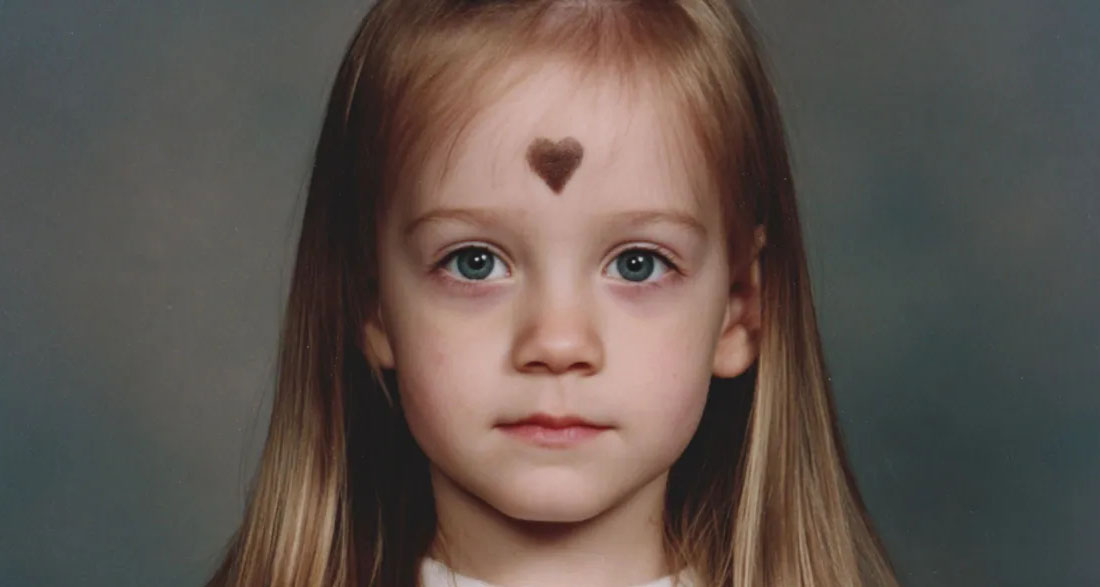
I grew up believing the birthmark on my forehead was the worst thing about me. From the very beginning, I thought it was something ugly, something I had to hide.
I spent years trying to cover it with my hair, with makeup, with carefully practiced angles in mirrors. And when I was finally old enough, I scheduled surgery to erase it completely. I truly believed that once it was gone, my life would finally begin.
Then one day, during a job interview, a man I had never met before looked at me and said words that made my blood run cold.
“You’re dead,” he said. “You were supposed to be dead.”
What he said after that left me shaking in my chair.
I was born with a dark birthmark right in the middle of my forehead.
The kind of mark that makes people stare for a second too long, then quickly look away like they didn’t mean to. The kind that makes silence feel loud.
In elementary school, kids didn’t try to hide their curiosity or their cruelty.
One afternoon in the cafeteria, a boy leaned across the lunch table and squinted at my forehead like he was trying to solve a mystery.
“Did you hit your head?” he asked.
Another kid laughed and said, “It looks like paint.”
Everyone around them giggled.
I remember staring down at my milk carton, my face burning, pretending I didn’t hear anything at all. I told myself I was somewhere else, that none of it mattered.
You learn that trick early when you have to.
But it didn’t stop there. It only got worse.
By middle school, everything was louder. The hallways, the lockers, the whispers. Kids who barely knew my name suddenly felt entitled to comment on my face.
One afternoon, a girl I barely knew cornered me in the bathroom. She folded her arms, looked straight at my forehead, and said, “You should cover that up so the rest of us don’t have to look at it.”
I told a teacher once. My voice was small when I explained what was happening.
She gave me a tight smile and said, “Kids can be mean. Try not to let it bother you.”
I nodded and walked away, even though I wanted to scream. How was I supposed to not let it bother me when it followed me everywhere I went?
At home, my adoptive mom would gently tuck my hair behind my ear and say, “It makes you unique.”
My dad would nod and add, “There’s nothing wrong with you. Not one thing.”
I believed them.
I just also believed the kids.
That’s something nobody really warns you about. Loving parents can give you warmth, safety, and strength, but their love doesn’t stop the whispers in the hallway or the way people look at you like you’re something to be judged.
By the time school pictures came around, I had mastered my angles. Chin slightly down. Face turned just enough. Bangs pulled forward to cast a shadow.
“Hold still,” the photographer would say every year.
I always did.
In high school, I stopped raising my hand even when I knew the answer. I didn’t want heads turning toward me. I didn’t want eyes on my face.
Being invisible felt safe, even if it meant pretending to be smaller than I really was.
Once, a boy I liked asked, “Why do you always wear your hair the same way?”
I laughed and said, “Habit.”
He nodded like that made sense, and we never talked about it again.
I survived school by becoming very, very good at not being seen.
For a long time, I believed the birthmark was the worst thing that had ever happened to me. I blamed it for every insecurity, every moment of doubt, every time I shrank myself.
I told myself that if I could just get rid of it, everything would change. I wouldn’t have to hide. I could finally be free.
By my 20s, I had a savings account with one goal: cosmetic surgery to remove my birthmark.
I worked as a marketing coordinator after college and saved every extra dollar. I scheduled doctor consultations during lunch breaks. The offices were clean and quiet, and the doctors spoke calmly about “options” and “minimal scarring” while I nodded and tried not to cry.
The surgery was scheduled for two weeks later.
I told my friend Amber over coffee one afternoon.
“I finally scheduled it,” I said, barely able to hide my excitement. “In two weeks, it’ll be gone forever.”
She studied me and said, “You’re really excited about this, huh?”
“I think I’ll feel lighter,” I told her. “Like I won’t have to think about it anymore.”
She reached across the table and said gently, “You know you don’t need to do this, right? I’ve never thought there was anything wrong with you. But if this is what you want, I support you.”
That was enough for me. I didn’t need her to fully understand. I just needed her not to judge.
I marked the surgery date on my calendar and told myself that after that day, life would finally be easier.
Then I got the email.
I’d been invited to interview for my dream job. The kind of opportunity you don’t expect to actually get.
For a moment, I almost canceled the surgery just to avoid dealing with both things at once. My brain couldn’t handle the stress.
Instead, I did something I almost never did.
I pulled my hair back.
Looking back, I know I wouldn’t have done that if it weren’t for Amber’s words. That one small act of bravery changed everything.
I stood in front of the mirror and told myself, “If they don’t hire me because of a birthmark, I don’t want the job anyway.”
It sounded strong in my bathroom.
It felt terrifying when I walked into the building.
The office was modern and quiet, all glass and soft colors. I sat across from the assistant, answering questions. Everything was going well.
Then the door opened.
My future boss walked in.
He looked confident, put together, the kind of man who seemed unshakable. He was looking down at his tablet as he entered.
Then he looked up at me.
And froze.
The color drained from his face. He stumbled backward like he’d been struck.
“No,” he whispered. “No, no. That can’t be true.”
The assistant stopped typing. “Sir?”
He waved her out of the room without looking away from me. His hand was shaking.
“Please,” he said. “Give us a moment.”
When the door closed, he sank into the chair across from me, staring at my forehead like he was afraid I’d disappear.
“That mark,” he said quietly. “That exact mark.”
My heart was pounding.
“I’m sorry,” I said. “Do I know you?”
His voice cracked as he answered, “No. But I think I know you. I never thought I’d see that mark again. Not after they told me you were gone.”
I whispered, “I don’t understand.”
He took a deep breath. “Twenty-five years ago, the woman I loved left town while she was pregnant. Later, she told me the baby didn’t survive.”
He swallowed hard. “She sent me one photo. The baby had a birthmark. Right there.”
Then he asked, “Your mother… is her name Lila?”
“I don’t know,” I said. “I was adopted as a newborn.”
His eyes filled with tears. “She lied to me.”
“You think I’m your daughter,” I said softly.
He nodded. “Would you agree to a DNA test?”
I didn’t know how to process any of it, but I nodded. “Okay.”
The test came back fast.
We opened the results at my parents’ house. The ones who raised me. The ones who chose me.
It was a match.
My mother cried. My father held my hand and didn’t let go.
“I have parents,” I said gently. “They raised me.”
“I know,” he said, nodding to them. “And I’m grateful.”
A few days before my surgery, the clinic called to confirm my appointment. I stood in front of the mirror with my hair pulled back.
The birthmark I’d hated my whole life wasn’t a flaw.
It was proof.
I called the clinic back and said, “I need to cancel.”
“Are you sure?” the receptionist asked.
“I’m sure.”
I didn’t suddenly love my birthmark. This isn’t that kind of story.
But I learned I didn’t need to erase myself to deserve a place in the world.
The mark on my forehead wasn’t a mistake.
It was a map that led me home.
And that was enough.