


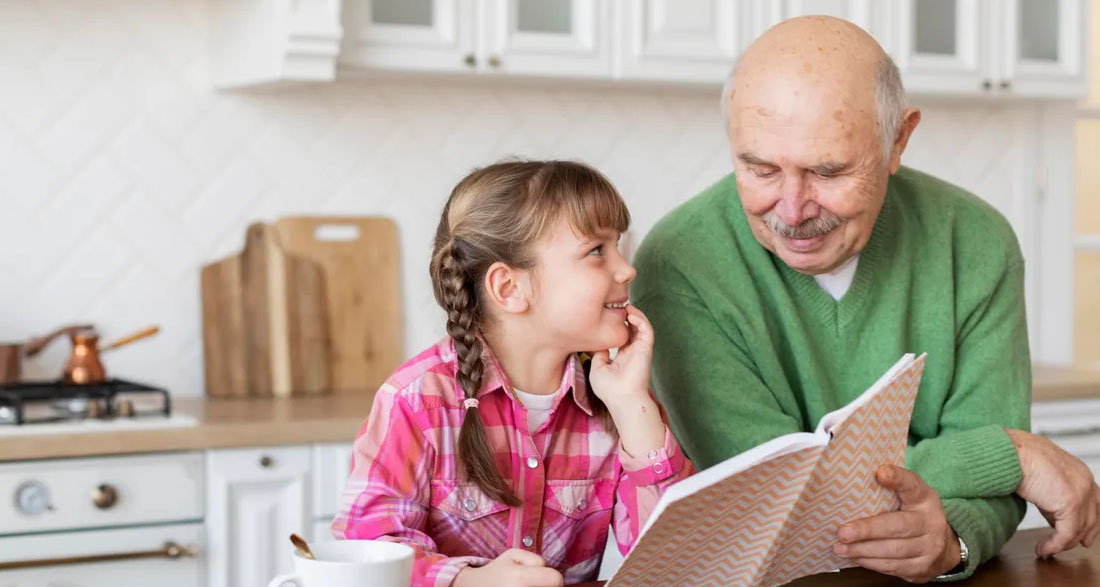
My granddaughter Lily used to run straight into Grandpa Jim’s arms the second she walked through our door.
She didn’t hesitate. She didn’t look around. She just ran. But one week, when she came to stay with us, she refused to hug him goodnight. At first, I thought she was just tired. Then, that night, as I tucked her in, she looked up at me from under her eyelashes and whispered, “Grandma… he’s different.”
Lily had always adored my husband. She loved him as if he held the moon in his hands.
The moment she walked through our door, she made a beeline for him. Arms wide, feet racing, voice bright: “GRANDPA!” she would yell. She would wrap herself around him, small but determined, and announce, “I’m here!” like she was reporting for duty.
She called Grandpa Jim her “favorite person.”
He taught her to ride a bike without training wheels, to shuffle cards with style, and to whistle through her fingers so loud it could wake the neighbors.
He let her wear his old baseball cap around the house like a crown, and she giggled every time. He pretended he didn’t like being called her “favorite person,” but I knew better.
One Monday, my daughter Erin called early.
“Mom,” she said, voice tight and tired, “can Lily stay with you for a week?”
“Of course,” I said without hesitation. “Bring her tonight.”
Erin paused. “Thank you. We’ve got… work issues. It’s complicated.”
I nodded, though I didn’t fully understand. For the first three days, everything felt normal.
That evening, Lily burst out of the car and sprinted up our driveway.
“GRANDPA!” she screamed.
Jim opened his arms, and she crashed into him so hard he grunted.
“Easy, kiddo,” he laughed, steadying her. “You’re getting strong.”
“I’m seven,” she said, as if that explained everything.
Pancakes for breakfast, board games in the afternoon, Jim letting her win while she pretended not to notice—all of it felt like our usual, warm rhythm.
Then, on the fourth day, Lily changed.
She became quiet. She followed Jim from room to room, watching his every move. She perched at the counter while he made coffee, narrating every step in a solemn voice.
“First you scoop,” she said. “Then you pour. Then you wait. Then you do not drink it because it’s yucky.”
Jim looked at me and grinned faintly. “See? I’m raising a critic.”
Dinner that night was quiet. Lily pushed peas around her plate, answering Jim with polite little “yes” and “no.”
Jim tried to keep it light. “Hey, Lil, want to play cards after?”
She shook her head slightly. “No hug tonight?” he asked, half teasing.
“Maybe later,” she muttered, barely looking at him.
Later, as she brushed her teeth, Jim stood near the couch, waiting like he always did. I smiled softly. “Go give Grandpa a hug before bed.”
Lily froze in the hallway. She looked at him, then shook her head once.
Jim’s smile held, but it was strained. “No hug tonight?”
“I’m sleepy,” she said, voice tiny.
“Grandma… he’s different.”
Jim nodded slowly. “Okay. Sleep tight.”
She walked into the guest room and closed the door.
When I tucked her in, she stared at the ceiling, lost in thought.
“Sweetheart, why didn’t you hug Grandpa? You always do,” I asked softly.
She waited, measuring her words. Then, finally, she whispered, “Grandma… he’s different.”
“What do you mean?” I asked. My heart tightened.
“I got up for water. I heard noises,” she said.
My chest squeezed. “Different how?”
Lily swallowed. “He was crying.”
I blinked. “Grandpa… crying?”
She nodded. “Last night. I got up for water. I peeked in the kitchen. He had his head down, hands on his face, shaking. Grandpa never cries. He looked… small.”
I held her hand tightly. “Thank you for telling me, sweetheart. You did the right thing.”
“Can I talk to him?” Her voice wobbled. “Is he mad at me?”
“No, honey. You didn’t make him cry. Sometimes grown-ups cry. Even strong ones. It doesn’t mean you’re unsafe.”
“But he’s different,” Lily whispered again.
“I know. I’ll talk to him, okay?”
The next morning, I watched Jim more closely. He laughed lightly, almost to himself, pretending nothing was wrong.
But there were moments—his pause at the counter, his hands lingering over the sugar—that made my heart skip. That night, sleep barely came. I kept picturing him alone at the table, head down, trying not to make a sound.
That afternoon, I found him in the den, papers scattered across his desk.
“You okay?” I asked gently.
“I’m fine,” he snapped, but then softened. “Sorry, kiddo. Grandpa’s distracted.”
Lily stepped back, sensing the tension, and stayed close to me, twisting the hem of her shirt nervously.
Later that night, after Lily was in bed, I confronted him.
“We need to talk,” I said softly.
“About what?” he asked, voice guarded.
“Lily. She saw you crying.”
His face went blank. “She shouldn’t have been up.”
“Jim. Tell me what’s going on.”
“I was tired. I had a moment,” he admitted.
“A moment doesn’t make a child stop hugging you. She thinks something is wrong.”
“Kids are dramatic,” he muttered.
“Don’t dismiss her. Tell me.”
He shook his head. “Nothing.”
“Jim.”
“Drop it,” he barked.
I hated snooping, but I couldn’t leave Lily in fear alone. I opened the den drawer. Inside were appointment cards, pamphlets, and printouts with bold headings: Neurology. Cognitive assessment. Follow-up.
Jim froze in the doorway. “You went through my things.”
“I did. You wouldn’t tell me,” I said.
For a moment, anger flashed across his face. Then his shoulders sagged.
“They said it’s early,” he whispered. “They love that word.”
“Early what?”
“Early dementia. More tests. They said Alzheimer’s is possible.”
The room tilted. I couldn’t breathe.
“I’ve been forgetting things. Names. Why I walked into a room. I re-read and it doesn’t stick,” he said, voice trembling. “I don’t want to be a burden.”
“You’re not a burden, Jim. You’re my husband.”
“And Lily,” he whispered. “She looks at me like I’m the safest place. I didn’t want that to change.”
My throat burned. “So you cried alone.”
He nodded, shame and sorrow in his eyes.
I held him. “We can’t hide this anymore.”
We called Erin and Daniel, told them the diagnosis, the plan, the truth. No more secrets. Erin cried, Daniel sat tight-lipped but steady.
We made a plan: appointments, support, insurance, school coordination. We picked an “anchor” routine for Jim and Lily—something simple they could do together, even on bad days.
That evening, I sat on Lily’s bed. “Sweetheart, can we talk about Grandpa?”
“He just might need more help sometimes,” I said.
Lily’s eyes widened. “Is he okay?”
“He’s going through something hard. Sometimes his brain gets mixed up. That makes him sad.”
She thought a moment. “So he cried.”
“Yes, and that’s okay.”
“Is he still Grandpa?”
“Yes. He’s still Grandpa. He just might need more help sometimes.”
We walked into the living room together.
“Hi, kiddo,” Jim said, voice shaky.
“You’re still my favorite,” Lily said bravely.
“Grandpa, you were crying,” she added.
“I was. I’m sorry you saw that,” he admitted.
“Are you mad?”
“Never. I was sad. But I’m still me.”
“You’re still my favorite,” Lily repeated.
Jim knelt, voice broken. “I’m lucky, then.”
“Are you scared?” she asked. Hugging him tightly.
“No more secrets,” she whispered.
Jim promised, “No more secrets.”
After Lily went to bed, Jim and I sat in the kitchen.
“I thought if I pretended it was small, it would stay small,” he admitted.
“We don’t get to pretend. We face it,” I said, holding his hand.
Two days later, Lily left, hugging him before she went. She wore his old baseball cap like a crown, serious, steady.
I drove to the cemetery. The wind was sharp. The sky too bright. I let the fear come, then forced myself up. My husband meant the world to me, and I needed to be strong for him.
When I returned home, Jim was in the kitchen with his book.
“You okay?” he asked.
“No,” I admitted. “But I will be.”
He gave a small, tired smile.
I walked to him and wrapped my arms around him. He held me back, solid, warm. For now, he was still here.