


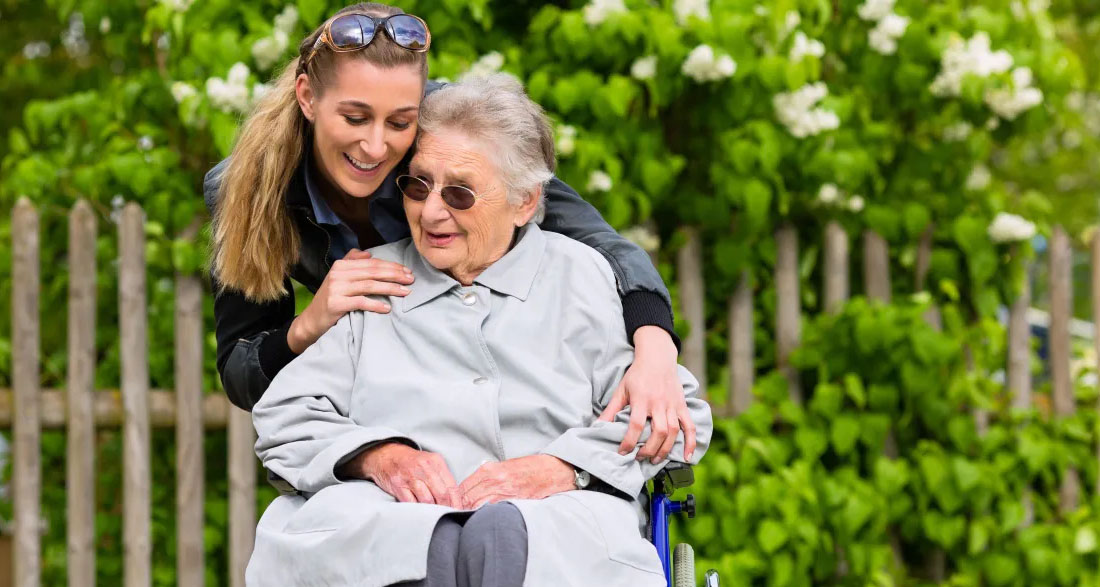
My brother didn’t call Grandma for five years. Not on her birthday. Not when she had her stroke. Not when I carried her down four flights of stairs because her legs refused to cooperate.
Then, one afternoon, during a casual family video call, someone casually mentioned Grandma’s $500,000 savings. And suddenly… William appeared, holding a handful of gas station flowers, thinking this would be easy.
He couldn’t have been more wrong.
Our grandmother, Dahlia, was the rock of our lives. After our parents died, she raised me and William, even though she was already in her late 50s, working back-to-back shifts at a diner—breakfast and dinner—just to keep us afloat.
No matter how tired she was, she always sat with us at the kitchen table before dinner, helping us with homework, making sure we didn’t fall behind.
She worked at that diner until she was 69. And alongside it, she quietly built a small home business, something that would one day grow into a modest fortune.
I stayed with Grandma after school. I was there when her breathing became shallow, when her legs began to fail on the stairs, and when the doctors insisted she needed fresh air every day.
The building had no elevator, so I carried her down in the morning, back up in the evening, her arms around my neck, mine around her waist. We’d sit on the front steps together for an hour, just watching the street, talking quietly, sharing the rhythm of our days.
William left the week he turned 18 and didn’t look back for five years. No calls. No visits. Not even a word on her birthday. I was the one sitting in the hospital, holding her hand while the monitors beeped and the doctors whispered updates I didn’t want to hear.
Then came the family video call.
It was just a casual check-in, a dozen of us in little squares on the screen. My uncle mentioned helping Grandma organize some paperwork. That’s when my cousin Danny, who never knows when to stop talking, blurted out, “Grandma Dahlia got more set aside than any of us knew. Close to half a million!”
The room went silent.
Exactly twenty seconds later, William’s face popped up in the corner of the screen. He’d been quietly lurking there the whole time, almost invisible in the bottom right corner.
“Did she say how it was split?” he asked casually.
I closed my laptop. I didn’t want to hear more. He had been absent for five years, and now he suddenly cared about Grandma because of money.
That evening, William was at Grandma’s door. Gas station carnations in hand, price sticker still on them.
He started crying before he even crossed the threshold, telling her how much he’d missed her, how hard life had been, and how he wanted to make it right. He sat by her bed, held her hand, whispered to her—and I stood in the kitchen doorway, watching the entire performance.
When he finished, Grandma squeezed his hand and said, “I’m leaving everything to you, Willie… if you can prove you understand what it takes.”
William’s shoulders relaxed, a triumphant look in his eyes, as if he had already won.
Then Grandma reached under her pillow and pulled out a cream-colored folder, tied with string. She handed it to him. “Every dollar will go to you, son. But only if you follow one condition.”
“Anything, Grandma!” he said, barely hiding his excitement.
“Read it out loud,” Grandma said, smiling.
William opened the folder and started reading. And as he read, the color drained from his face:
“One week. One week living exactly as I’ve lived while raising Ruby and you. In my apartment. No car. No savings. No outside help.
Only the daily tasks assigned to you. You must cook every meal, clean everything, manage my medications on schedule, and carry me down the stairs in the morning and back up in the evening. You must be present through my difficult nights.
Your sister, Ruby, will supervise everything. Her word is final. No exceptions.”
He looked at me, stunned. “You knew about this?”
I shook my head. “Not a clue.”
“Are you serious?” he asked Grandma.
“You said anything,” she reminded him.
“Fine. One week,” he muttered, already scheming in his head.
Day one, William treated it like a joke. He burned Grandma’s oatmeal—the same bowl of steel-cut oats she had eaten every morning for decades—by walking away to check his phone. He dumped the burned oats in the trash without an apology and looked at me like I’d fix it.
I made him start over.
By day two, he was complaining about the stairs, the medication schedule, and how long the shopping list was. “Why does she need to go outside twice a day?” he snapped.
“Because Grandma always did!” I said, sending him to fetch her walker.
By day three, his joke stopped being funny. He was exhausted, confused by the salt and sugar jars, turning soup into dessert by accident.
By day four, he tried to cut corners, leaving dishes half-washed and missing Grandma’s midday medication by 40 minutes because he was texting his girlfriend. I caught it and handed him a new list of tasks without argument.
By day five, he had stopped complaining. He was just doing the tasks—roughly, imperfectly, and without pride—but doing them. That was more than he had done in the past five years.
Day six, laundry day, he was in the courtyard pinning Grandma’s clothes to the line. Mrs. Calloway from 4B, a neighbor who had known Grandma for decades and had brought soup when her hip was bad, stopped to watch.
“Well, look at that!” she said finally.
William forced a small smile. “Just visiting!”
“Funny,” she replied. “Some visits take five years to happen.”
He kept working, silent, and for the first time that week, honest.
That night, Grandma had a rough night. Her hip pain woke her at 3 a.m. William, awake and standing by her bed, tried repositioning her. She winced. He stopped.
“Show me again,” he asked.
I guided him through it. This time, he was careful, patient. Grandma exhaled and relaxed. He stayed at her side all night, without anyone supervising.
The next morning, he was asleep in the chair beside her bed. That night was the first thing he had done out of care, not obligation.
By day seven, he dropped a dish towel on the table at noon. “I’m done,” he said.
“You have until this evening,” I reminded him.
“I know when the deadline is, Ruby,” he snapped.
Grandma looked at him. “Ruby didn’t make it difficult. That was my life, dear.”
“I thought showing up was enough,” William said.
“Showing up was never part of your plan,” Grandma said. “Only arriving was.”
Then she smiled, revealing the twist we hadn’t seen coming. “I planned this. I asked your uncle to mention the paperwork. I knew you would hear about it, Willie… and I knew you would come back exactly like this.”
“You set me up,” he said, shocked.
“I gave you a week to understand something,” she corrected. “I wanted you to understand what it takes to be here for someone—not for money, not for show. If you truly cared, I was willing to set something aside for you. That was the plan.”
He stood, jacket in hand, and turned to leave. “I don’t want it.”
The next morning, Grandma took my hand. “Everything goes to you, Ruby,” she said, holding me close. “That was always the plan. I just needed your brother to see what it took for you to be here for me. I hope he finds his way back. If he does, it will be your choice to decide if he deserves a share.”
Tears stung my eyes.
“You never made me feel like a burden,” Grandma added. “Not once. Not when I couldn’t walk. Not when I couldn’t sleep. Not when I was at my worst. That is worth more than any of this.”
“I didn’t do it for the money, Grandma.”
“You never made me feel like a burden.”
Her sharp, knowing look met mine. “That’s the point, Ruby.”
It’s been less than 24 hours. William isn’t answering calls. He probably thinks I manipulated Grandma.
But love isn’t bought with money. And that is something William will learn—if he ever does.
He wanted the reward. He just wasn’t willing to live the life that earned it.