

The final argument was like someone striking a match in a room full of gasoline fumes. It didn’t explode right away, not at first, but I could feel it burning under the surface. And like so many of the fights before it, it started with the same tired villain: money. Or, to be more accurate, the sad, sagging absence of it.
Marcus had become obsessed with this lake house he was building, the one he bragged about nonstop. According to him, it was going to “prove he had finally arrived,” the crown jewel of his career.
But really, it was a sinking boat made out of our savings. And by the time he started talking about credit cards and personal loans, our accounts had already turned into a horror movie.
That morning, he said it over scrambled eggs as casually as someone asking for more napkins.
“Naomi, I need another seventy‑five thousand,” he told me, reaching for the salt.
I froze. My coffee hovered halfway to my lips, and my heart seemed to get stuck right in my throat.
“Where are we going to get that kind of money?” I asked. “We already owe the bank a fortune. My salary barely covers the interest.”
He looked at me with this cold, cutting hardness I hadn’t seen in years. “I’m not asking,” he said. “I already finalized everything with the contractors. I need the money by the end of the day.”
“You finalized what without telling me?” I shot back. My voice came out sharp and metallic, like something scraped along a blade.
Marcus slammed his hand down on the table, making the plates jump. “This house is our future.”
“You’re building a show,” I said. “Not a future. At least my garden still feeds us.”
That was the spark. He stood up so fast his chair scraped across the floor, his face full of contempt.
“I’m sick of your petty complaints,” he snapped. “Get dressed. We’re leaving.”
“Leaving? Where?”
“To meet someone,” he said. Then he added, with a voice that brooked no argument, “Don’t bring anything.” He even told me to leave my purse and my phone. And after fifteen years of marriage, with all the small humiliations and slow grinding down he had trained into me, I obeyed. I grabbed a light jacket and followed him out.
The drive was tight with silence, the kind that feels heavy enough to crush ribs. A few minutes later, he veered off the highway and headed into a lonely road lined with dying pines and scattered vacation homes. It was the kind of place where no one hears anything unless they want to.
He stopped beside a sad-looking bus shelter, the kind with a rusted roof and peeling paint. He killed the engine.
“Get out,” he said.
I stepped outside onto the gravel shoulder, wind slapping my hair into my face. Marcus didn’t even turn the car off. He just watched me like I was an item he’d been meaning to return for years.
“Marcus, what’s going on? Where’s the person we’re meeting?” I asked.
“There is no person,” he said, flashing a cruel smile. “There’s you. And your constant problems with money. I’m leaving you. Start your life right here.”
He hit the gas. The car shot forward, kicking up dust, and disappeared.
I stood there, stunned and shaking. It was too absurd to be real. Any second, I thought, he’d come back, laughing, telling me it was some twisted joke. But the road stayed empty. The car just shrank and vanished into nothing.
I had no phone. No wallet. Eighteen miles to the city on foot. My panic rose so fast it made my vision swim. I sat on the shaky bench under the bus shelter’s rusted roof and let the cold settle into my bones.
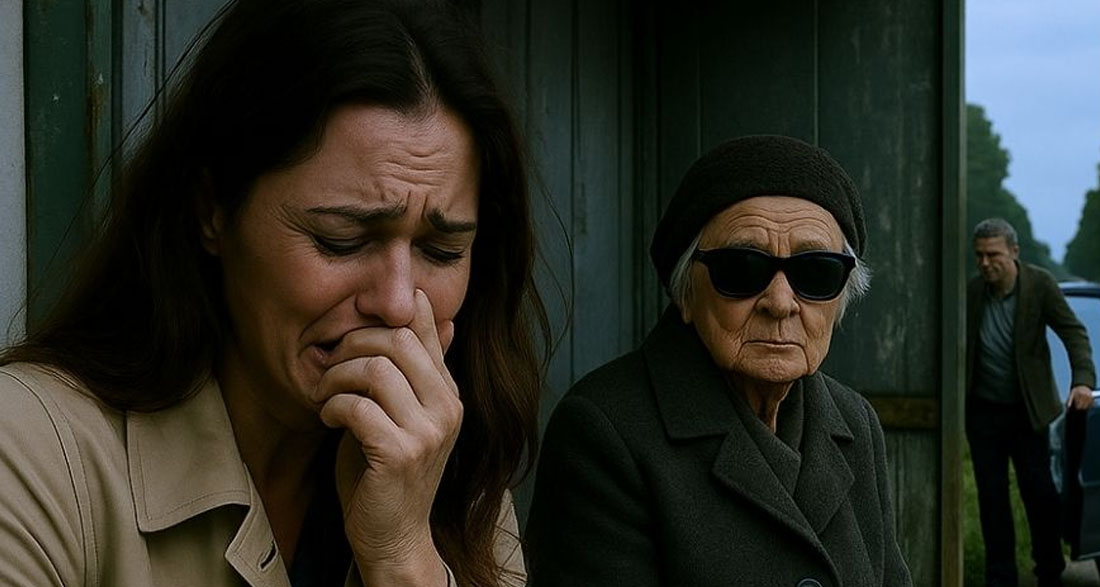
I didn’t even notice the old woman until she stirred. She was sitting in the dark corner of the shelter wearing big dark sunglasses, the kind blind people sometimes use. Her coat looked old but expensive.
Without turning her head, she spoke in a dry voice. “Stop crying. Tears won’t help your situation.”
I swallowed a sob. She waited a moment, then asked, “Husband dumped you?”
I couldn’t even answer. She tapped her cane against the concrete. “Want to make him regret it?”
“How?” I managed. “You’re… blind.”
“My driver is coming,” she said. “Pretend you’re my granddaughter. You’ll get in the car with me, and we’ll leave. And yes, he’ll regret it.”
Right on cue, a long black car glided around the bend like something out of a movie. A man in a perfect suit stepped out, opened the door, and said softly, “Ms. Vance, we’re ready to depart.”
The old woman stood. “My granddaughter is riding with us today.”
The driver gave me one neutral, polite look. That was all it took. Next thing I knew, I was sliding into the plush back seat.
The sedan smelled like expensive leather and quiet secrets. We drove past empty fields until, shockingly, the road opened onto the grounds of a massive mansion, a place with high security cameras, trimmed lawns, and an atmosphere that wasn’t cozy so much as commanding.
Inside, the woman removed her sunglasses. Her eyes were not blind. Not even close. They were sharp, cold, observant.
“My name is Eleanor Vance,” she said. “You are Naomi Sterling, thirty‑eight years old, an administrator at the manufacturing plant. Your husband is Marcus Sterling, forty‑two. Correct?”
I nodded, too stunned to speak.
She poured me a glass of water and pushed it toward me. “Drink. You’ll need your strength.”
She explained she had seen everything: the argument, the abandonment, the way he left me like trash. “He didn’t merely leave you,” she said softly. “He staged your humiliation. He wanted you diminished.”
Then she offered help. Clothes. Lawyers. Resources. But not for free.
“What do you want?” I whispered.
“You’ll owe me,” she said. “And when I ask for repayment, you’ll give it.”
And something inside me, raw and furious and hurting, whispered back, “Deal.”
From the moment she pulled me into her world, nothing was simple again. She gave me a phone, a polished new identity, elegant clothing, and a calm lawyer named Josiah Wells. But the help came with sharp corners. Eleanor insisted I go home and see what Marcus had done.
Darius, her driver, dropped me at the block. I walked toward the building with trembling hands.
My key wouldn’t turn in the lock.
Not the bottom. Not the top. New hardware gleamed back at me like a slap.
A neighbor peeked from upstairs, then shut their door fast.
Then Marcus came down the stairs holding hands with a young, elegant woman. Tiffany Chambers. The daughter of the district attorney. She was wearing my mother’s pearl pendant like it was hers. She even touched it casually, like she knew it would cut me.
Marcus handed the officers a stack of papers: divorce documents, a restraining order, and claims of my “instability.” He said he changed the locks for “their safety.”
Then came the worst part: a notarized purchase agreement showing that I had apparently sold him my apartment weeks ago. My signature looked neat, clean, convincing.
“It’s forgery,” I whispered.
Mr. Wells promised he would get forensic analysis. Marcus shrugged like he had just solved a minor inconvenience. The police softened toward him. Tiffany drifted into my apartment like she was already redecorating my life.
Hours later at the precinct, I answered questions that made my head spin. There was no comfort, no clearing of my name. Just procedure. And at the end of it, more ruin.
Back at Eleanor’s house that night, she gave me the next step. A charity gala in two days. Marcus would be there giving a speech. She would make me ready to confront him in front of the city.
She dressed me, styled me, and taught me to walk like I was someone who had nothing left to lose.
At the gala, after his speech, I stepped forward and asked loudly, “Where did you get the right to sell my mother’s apartment?”
Silence fell like a dropped curtain.
Tiffany pulled out her phone and played a video: me, weeks ago, drunk and giggling at a party. She held it up for everyone to hear. The laughter sliced through me. I felt trampled beneath the shoes of the city’s elite. Eleanor’s plan had failed.
The next morning was worse. My boss suspended me. Friends vanished.
When I called Eleanor, desperate, she didn’t blame Marcus. She blamed me.
“You’re weak,” she said coldly. “You let him use what I gave you.”
Then she offered a new deal. She had a folder of evidence against Tiffany’s father, the district attorney. If I delivered it to him and made him drop the charges against me, I’d keep my freedom. But I’d have to leave the city forever.
I refused.
That’s when she showed me her real power: forged contracts, hidden passports, secret bank transfers. Marcus was planning to run. And somehow, my digital signature had ended up on technical permits that could ruin me.
There was only one place to go: my family’s cabin at Willow Creek. I had Darius drive me there in the dead of night.
Inside, I found the original inheritance papers for my apartment, exactly where they should be. Proof Marcus had forged everything.
Then, beneath a loose floorboard, I found the safe. Inside were new passports with Marcus’s and Tiffany’s photos. They were fleeing. Next to the passports were permits with my certified digital signature. The fraud was bigger than the apartment. They wanted me as the scapegoat for a multimillion-dollar scheme.
I called my sister, Tia. Begged her to meet me at an all-night diner. She showed up pale and worried. I gave her the blue folder with the real papers and told her to take them to a lawyer friend in New York for safekeeping.
She promised she would.
But the next morning, paramedics and detectives arrived at Eleanor’s mansion with a warrant. They arrested me for fraud and forgery. They had the folder. The one Tia was supposed to take away.
Detective Hayes said, “Anonymous informant.” Tia had sold me out. My sister helped destroy me. It hit like a gut punch.
The interrogation was brutal. Cold questions. No mercy.
Eleanor bailed me out again. Josiah, my lawyer, was furious. The case looked airtight. And Tia was the star witness.
Eleanor said court would be useless. But she gave me one more name: Leonard Price. A brilliant investigative reporter turned washed-up ghost. He hated Marcus. He wanted money. He still had enough fight to dig.
Leo followed the money and found regular transfers into a secret account. Someone was blackmailing Marcus, pushing him deeper into crimes. The trail led to a cigarette pack with a gold crest he recognized: Darius’s brand. Eleanor’s driver was delivering envelopes to the blackmailer.
It hit me: Eleanor hadn’t just helped me. She’d set Marcus up. I had been her weapon.
Watching Darius hand off money from behind a tree, I felt the last illusion inside me crack and crumble.
We didn’t go to Chambers. We went after greed instead. Leo planted a story about Swiss investors wanting to buy Marcus’s project rights. Then a mysterious deposit of $125,000 showed up in Leo’s account. Eleanor was still pulling strings from the shadows.
Marcus swallowed the bait. He called, frantic. He wanted to meet the “investors” at the plant. He demanded a midnight meeting in my old office. He wanted it simple, quiet, final.
Fine. If he wanted a stage, we’d give him one.
We brought cameras, sympathetic federal agents, hidden mics, and actors posing as investors. I recorded a fake conversation with Marcus using a voice-changer and kept his desperate replies.
At seven, I walked into my old office with a calm I didn’t feel. I carried the notarized transfer he wanted so badly.
Then the spotlights lit up the yard like a stadium. Agents surrounded the building. Leo blocked one exit. The fake investors covered another. The playback of Marcus’s voice filled the office: his promises to silence Chambers, his negotiations with Tia, his crimes laid bare.
Agents stormed in. Chambers was cuffed. Marcus tried to fight and tripped into a filing cabinet, spitting threats that sounded like a dying animal.
Weeks later, new locks were drilled into my apartment door. The case unravelled. Tia’s lies fell apart under pressure. My lawyer regained his confidence.
Then came the call: “Naomi Sterling, good afternoon. Your appointment is signed. On Monday, you will head the planning department.”
I had saved the plant. And myself.
I had lost a husband, a sister, and any belief that help comes without a price. I had been humiliated, betrayed, nearly erased. And what I found, after walking through all of it, was something smaller but stronger than hope: myself.
Eleanor visited once more. She stood in my doorway, watching me lock my new door.
“You could have taken the easier road,” she said. “You chose otherwise.”
I didn’t answer. There were no words for everything she had taken and everything she had forced me to become.
I closed the door. It clicked with a deep, final sound.
Outside, the city kept moving, sharp and indifferent. Inside, my apartment smelled faintly of lemon oil and new wood. It was mine now. Fully mine.
And finally, for the first time, I had the right to decide who could enter.