


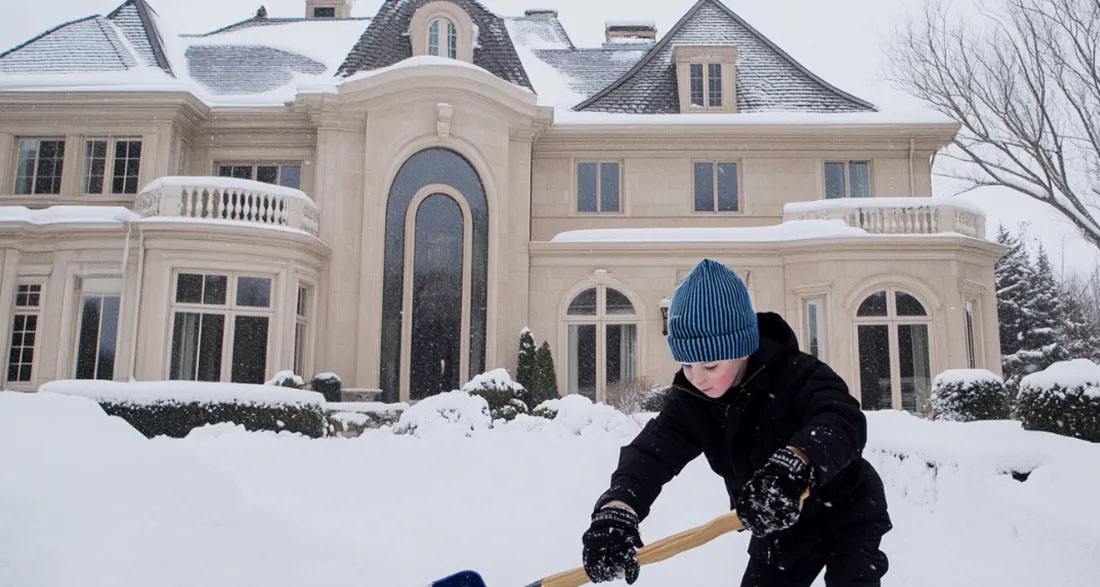
When my 12-year-old son Ben agreed to shovel snow for our rich neighbor for ten dollars a day, he felt like the luckiest kid alive.
He talked nonstop about the gifts he planned to buy for our family. But when that man suddenly refused to pay, calling it a “lesson about contracts,” Ben came home heartbroken. That was the moment I decided to teach that man a lesson he would never forget.
I had always known Ben was different. He was only twelve, but his heart was huge, and when he set his mind on something, nothing could stop him. He didn’t complain. He didn’t cut corners. He worked hard because he believed effort mattered.
I just never thought that belief would lead me to stand in an icy driveway beside my husband, getting payback on a grown man who thought cheating a child was just another smart business move.
It all started early in December, on a cold, snowy morning. I was in the kitchen making breakfast when I heard the scrape of a shovel outside. A few minutes later, the door flew open and Ben rushed in, his cheeks red from the cold and his eyes shining.
“Mom!” he said, almost bouncing. “Mr. Dickinson said he’ll pay me ten dollars every time I shovel his driveway!”
His smile was so wide it filled the room.
Mr. Dickinson was our wealthy neighbor, the kind who loved to talk about his businesses and show off his expensive cars and gadgets. He always acted like he was smarter than everyone else. I had no doubt he saw this as some kind of favor—letting Ben “earn” money under his wise supervision.
Still, Ben was thrilled, and I wasn’t about to ruin that.
“That’s wonderful, sweetheart,” I said, ruffling his hair. “So what are you going to do with all that money?”
“I’m buying you a scarf,” he said seriously. “And a dollhouse for Annie.”
His eyes lit up as he explained it all. The scarf would be red with tiny snowflakes, just like the one we’d seen at the store. The dollhouse would have working lights—the same one Annie had pressed her face against at the toy shop window.
“And,” he added proudly, “I’m saving what’s left for a telescope.”
I felt my chest tighten with pride. “You’ve really thought this through.”
He nodded fast. “Every bit of it.”
From that day on, Ben worked like it was his job. Every morning before school, he wrapped himself in his oversized coat, pulled his knit hat low, and headed out with his shovel. I watched from the kitchen window as he disappeared into the cold, the sound of metal scraping pavement echoing through the quiet street.
Sometimes he stopped to rest, leaning on his shovel, breathing little white clouds into the air. When he came back inside, his fingers were stiff, his cheeks bright red, but his smile never faded.
“How was it today?” I’d ask, handing him hot chocolate.
“Good! I’m getting faster,” he’d say, shaking snow off his coat and laughing.
Every evening, he sat at the kitchen table with a small, worn notepad, carefully counting his money. He treated that notebook like it was priceless.
“Only twenty more dollars, Mom,” he said one night. “Then I can buy the dollhouse and the telescope.”
By December 23rd, Ben was a snow-shoveling machine. That morning, he left the house humming a Christmas song, happy and confident.
An hour later, the door slammed open.
I rushed out of the kitchen. “Ben?”
He stood there frozen, boots half off, gloves clenched in his shaking hands. His shoulders trembled, and tears filled his eyes.
I dropped to my knees in front of him. “Sweetheart, what happened?”
It took a moment, but the words finally came.
“Mr. Dickinson… he said he’s not paying me. Not at all.”
My heart sank.
“He said it’s a lesson,” Ben continued, his voice breaking. “He said I should never work without a contract.” Tears rolled down his face. “Mom, I worked so hard. Why would he do that?”
I pulled him into my arms, anger burning in my chest. “Oh, baby,” I whispered. “You did nothing wrong. This is not your fault.”
I brushed his hair back and looked him in the eyes. “You don’t worry about this. I’ll handle it.”
I grabbed my coat and marched across the lawn. Mr. Dickinson’s house was glowing with Christmas lights. Music and laughter floated out as I rang the bell.
He opened the door with a wine glass in his hand, wearing a smug smile. “Mrs. Carter,” he said. “What brings you here?”
“You know exactly why,” I replied. “Ben worked for you. You owe him eighty dollars.”
He laughed. “No contract, no pay. That’s how the real world works.”
I took a deep breath. “You’re right,” I said calmly. “The real world is about accountability.” I smiled sweetly. “Enjoy your evening.”
By the time I got home, I had a plan.
Early the next morning, I clapped my hands loudly. “Up, everyone. Let’s go.”
Ben blinked sleepily. “What’s happening?”
“We’re fixing a wrong,” I said.
Outside, my husband fired up the snowblower. Ben grabbed his shovel like it was a sword. Even little Annie came along with her toy shovel, excited to help.
We cleared our driveway, then the sidewalk, pushing every bit of snow toward Mr. Dickinson’s spotless driveway. Pile after pile grew higher.
“This is a lot of snow,” Ben said, smiling.
“That’s the idea,” I replied. “Think of it as justice.”
By mid-morning, his driveway was buried. The snow was higher than the hood of his fancy car.
Soon, Dickinson stormed outside. “What did you do to my driveway?!”
I smiled. “Oh, that’s called undoing unpaid labor. Since you didn’t pay Ben, you don’t get to enjoy his work.”
Neighbors watched quietly as Dickinson realized he had lost.
That evening, he returned with an envelope. “Tell your son I’m sorry,” he muttered.
Inside were eight ten-dollar bills.
Ben hugged me tight. “Thanks, Mom.”
“No,” I said softly. “Thank you for showing me what hard work and heart really mean.”