

Wheels and All
The fluorescent lights in Franklin’s Corner Market buzzed softly, like tired insects trapped above the evening crowd. People were grabbing last-minute groceries, comparing prices, chatting quietly. Nothing dramatic. Nothing unusual.
Ryan Walker, a tired single dad in a jacket so old it had its own wrinkles, reached for a loaf of bread. That was when a voice exploded across the whole store, sharp enough to slice the air in half.
“I saw you slip that medicine into your bag!”
Everyone snapped toward the sound.
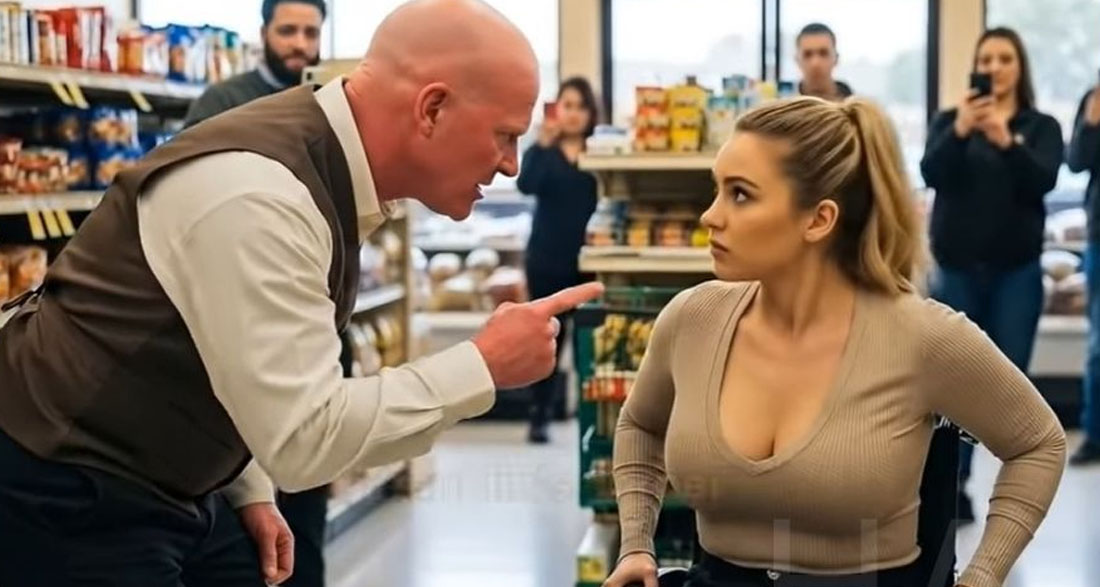
Behind the counter, the store manager, Mr. Franklin, was pointing at a young woman in a wheelchair. And not just pointing but jabbing his finger at her like he was trying to poke a hole through the space between them.
“Don’t think that chair means you can steal from me!” he barked.
The whole market froze. Some shoppers gasped. Others pulled out their phones, already recording, because drama always pulled people like magnets. Ryan’s little girl, eight-year-old Daisy, pressed herself into her dad’s side, gripping his sleeve.
The accused woman didn’t flinch. She sat tall in her chair, chin up, shoulders straight. Her hair, pulled back in a simple ponytail of soft gold, glimmered under the harsh lights.
“Sir,” she said calmly, “you’re welcome to check my bag, or the cameras. But I won’t be spoken to this way.”
Her voice was steady and brave, the kind of voice that makes you believe someone even before the proof arrives.
Franklin marched forward, grabbed her bag with a dramatic flourish, and dumped everything onto the counter. Out spilled a wallet, tissues, a tablet, and a single car key. That was it. No medicine. No boxes. Nothing even close to theft.
But Franklin wasn’t satisfied. He sneered.
“Maybe you hid it somewhere else.”
He reached toward a pocket on her wheelchair.
Ryan’s voice cut through the store, deep and controlled.
“That’s enough.”
Every head swung toward him.
Ryan stepped in front of the manager, blocking him like a wall made of pure stubbornness. He crossed his calloused hands across his chest.
“You checked her bag. There’s nothing there.”
Franklin’s eyes flashed.
“This isn’t your business, Walker. Take your kid and go.”
“It became my business the moment you started harassing a customer without proof,” Ryan said, keeping his voice even.
Behind him, Daisy whispered, “Daddy, why’s that man yelling at her?”
The question hit him right in the chest. He’d spent years teaching his little girl what kindness looked like. Now she was seeing the opposite.
The woman met Ryan’s eyes. Her eyes were hazel, sharp with intelligence, but also softened with gratitude.
“I’m Hannah,” she said quietly. “Thank you. But I can handle this.”
“Can you?” Franklin snapped. “Tony, call the police.”
The security guard, an older man with tired eyes, shifted uncomfortably.
“Sir… maybe we could check the cameras first,” he suggested.
“Don’t bother,” Franklin snapped back. “She’s not welcome here. Her kind never is.”
The whole room seemed to inhale and hold its breath at once.
Ryan’s jaw tightened.
“People who what?” he asked coldly. “Use wheelchairs?”
Franklin’s face turned tomato-red. “I— I meant troublemakers.”
“You’re the only troublemaker here,” Ryan said.
He crouched beside Hannah and helped gather her belongings. Daisy knelt down too, picking up tissues with tiny, careful hands.
“Thank you,” Hannah said softly to them both. “It’s nice to know decent people still exist.”
“There are more of us than you think,” Ryan said. “Come on. We’ll walk you to your car.”
Outside, the November wind slapped them with cold air. Ryan instinctively stepped between the wind and Hannah, shielding her as she rolled along the cracked sidewalk. He noticed how smooth her movements were. She wasn’t fragile. She wasn’t afraid. She knew exactly what she was doing.
“You didn’t have to help,” she said. “Most people just look away.”
“Is that what you wanted?” Ryan asked.
A small smile tugged at her lips. “No. I suppose not.”
When they reached her car, Ryan saw the modest sedan with hand controls. She transferred herself from the chair into the driver’s seat with practiced strength. Not a hint of hesitation.
“I’m Ryan,” he said. “And this is my daughter, Daisy.”
“Hi!” Daisy chirped. “Your car’s cool! It’s like my video game car!”
Hannah laughed, warm and full of sunlight. “It is, isn’t it? Makes driving an adventure.”
They chatted a little longer. Ryan mentioned another grocery store, one kinder and cleaner.
She said, “I usually go there Saturdays. Around this time.”
“Maybe we’ll see you there,” Ryan said.
“Maybe you will.”
As she drove off, Daisy looked up at her dad.
“Why was that man so mean to her?”
Ryan crouched down so they were eye to eye.
“Sometimes people see differences and get scared or angry.”
“But she’s just sitting in a chair.”
“Exactly.” He kissed her forehead. “You’ve got your mom’s heart, kiddo.”
That night, after putting Daisy to bed, he stood in the quiet apartment. The photo of Sarah, his late wife, watched him from the mantle. He whispered to it, “You’d have liked her.”
Weeks passed.
Every Saturday, Morton’s Grocery became their new routine. And every Saturday, Hannah was there — calm, dignified, and smiling like seeing them was the best part of her week. Soon, their little greetings turned into chats. Chats turned into laughter. Daisy zoomed around in a race-car cart while Ryan and Hannah joked in the produce aisle like old friends.
One day, as Hannah inspected apples with serious concentration, Ryan asked, “So what do you do?”
“Used to teach literature,” she said. “High school. Before… well, before.”
He understood that kind of unfinished sentence. Life dividing itself into “before” and “after.”
“My Daisy’s struggling with reading,” he admitted. “I try, but I’m better at fixing machines than explaining commas.”
“I could help,” Hannah said instantly. “If you’d like. No charge.”
“I couldn’t pay much,” he said.
“I wasn’t asking for money,” she replied. “Consider it a thank-you for that day.”
And just like that, Hannah became part of their world.
Every Tuesday and Thursday, she arrived with a stack of books on her lap. The apartment was small and worn out — uneven floors, noisy radiator, mismatched furniture — but she filled the whole place with stories. She taught Daisy that letters were tiny sparks waiting to ignite. Within weeks, Daisy was reading aloud, her voice glowing with pride.
One evening, after Hannah left, Ryan whispered to Sarah’s picture, “I don’t know what I’m doing. She’s different, but… maybe that’s the point.”
Then, one Thursday, Hannah didn’t come.
No call.
No text.
No answer.
Days passed. Daisy asked every night, “Is Miss Hannah okay?” And Ryan had nothing comforting to say.
Until the tenth day.
Hannah appeared at their door, pale, shaking.
“I’m sorry,” she said. “My father found me.”
Ryan frowned. “Your father? Did he hurt you?”
“Not with his hands,” she said bitterly. “With money.”
She told him everything.
Five years earlier, she’d worked as a riding instructor for disabled kids. She loved the job. Then a storm spooked a horse. She threw herself between the animal and a child, saving him. She lost the use of her legs.
Her father, Richard Brewster, had tried to rebuild her life using wealth instead of love — nurses, chauffeurs, endless medical services. A golden prison. She ran to escape it.
“And now he wants me to come home,” she said. “He thinks my ‘little rebellion’ is over. But this isn’t rebellion. It’s my life.”
Ryan stepped closer.
“What do you want?”
She blinked, startled.
“No one’s asked me that in a long time.”
“I’m asking now.”
Her voice dropped to a whisper. “I want to keep teaching Daisy. I want Saturday groceries. I want something real — something that’s mine.”
She hesitated.
“My father’s name is Richard Brewster.”
Ryan froze.
Brewster Technologies. A billion-dollar empire. Their logo was everywhere — hospitals, prosthetics, elevators.
“Your father’s a millionaire?” he whispered.
“Billionaire,” she corrected softly. “And yes, I could’ve bought that store. But money can’t buy decency.”
Ryan smiled gently. “You know what I saw that day? Someone brave.”
Her eyes filled.
“Most people pity me or try to use me. You just saw me.”
“Still do,” he said. “Wheels and all.”
That night, Daisy asked Hannah to read her bedtime story. Hannah’s voice warmed every corner of the room. Ryan found himself imagining a future he never thought he’d get again.
Then spring arrived like a breath of hope.
Hannah fit into their lives like she’d been meant for them. She tutored Daisy, joined them for dinners, laughed through nights when Ryan burned the spaghetti. Daisy started calling her “my Hannah.” And Ryan felt something in his chest waking up after years of silence.
But one evening, someone else knocked on the door.
When Daisy opened it, a tall man with silver hair and a suit that probably cost more than their whole apartment stood there.
“Hello,” he said, “I’m looking for my daughter.”
Hannah’s hands tightened on her wheels. “What are you doing here, Dad?”
“To apologize,” he said softly.
She studied him, then nodded. “Come in.”
Richard Brewster stepped inside. He looked around, taking in the small apartment, the warmth, the signs of a life Hannah wasn’t trapped in. His eyes softened.
“I’ve been wrong,” he said. “I tried to protect you because I couldn’t protect you from the accident. But you didn’t need protection. You needed respect.”
Tears filled Hannah’s eyes.
“I needed you to see me, Dad. Not the chair.”
“I see you now,” he whispered. “I’m proud of you.”
He looked at Ryan.
“And you gave her something I couldn’t. You gave her freedom.”
They had dinner together. Daisy, straight to the point, asked, “Are you sorry for being mean?”
Richard smiled. “Very sorry.”
Ryan could see real change in the man’s face. Not control. Not pride. Just relief.
Later, when Hannah and Daisy washed dishes, Richard leaned toward Ryan.
“You love her,” he said.
Ryan didn’t deny it.
“I loved her before I knew her name.”
“Then you’re the first man worthy of it,” Richard said.
Summer came blooming.
Hannah returned to teaching at the community college, testing new adaptive tech made by her father’s company — now with her advice shaping it.
Meanwhile, Franklin’s Corner Store got shut down for insurance fraud. In its place rose a Community Literacy Center, funded by an “anonymous donor” everyone knew was Richard.
And then, on a sunny September afternoon, Ryan brought Hannah to the riding arena where her life had changed forever.
“There’s someone who wants to meet you,” he said.
A little boy dashed forward. “Miss Hannah! My mom said you saved me! Thank you!”
He hugged her tightly. Tears rolled down her cheeks as she whispered, “You’re perfect. You’re why it was worth it.”
When the boy ran off, Ryan dropped to one knee beside her chair. He held out a small box with a sapphire ring.
“Hannah Brewster,” he said, voice trembling, “you taught me that love isn’t about fixing or saving. It’s about standing beside someone. Will you marry me? Wheels, chaos, spaghetti sauce and all?”
Hannah saw her father in the crowd, holding Daisy’s hand, nodding through tears.
“Yes,” she whispered. “Yes to all of it.”
Their wedding took place in the new literacy center. Wildflowers everywhere. Paper butterflies dangling from beams. People laughing, crying, celebrating.
Hannah wore a flowing white dress designed for movement, glowing. Daisy scattered petals way too early, earning giggles. Ryan stood at the altar in his only suit, heart racing.
“A year ago,” he said in his vows, “I thought I was standing up for a stranger. I didn’t know I was standing up for my future.”
Hannah wiped tears and said, “You saw me before you knew my whole story. You loved me like a person, not something breakable. I choose you, wheels and all.”
During the reception, Daisy tugged Hannah’s dress.
“Can I call you Mom now?”
“Of course,” Hannah whispered. “You already do.”
Richard stood to toast.
“My daughter doesn’t need protection anymore. She needs partnership. And she found it.”
As Ryan and Hannah danced, her wheels glided like part of the music. Daisy twirled between them, laughter echoing through the hall.
And months later, life offered one more gift.
One morning, Hannah stared at a small white test.
“Ryan,” she whispered, trembling. “I’m pregnant.”
Against all odds.
Doctors warned them to be careful, but they faced it as a team.
When baby Sarah Hannah Walker was born healthy and strong, the room filled with joy. Daisy kissed the baby’s forehead. Richard cried quietly at the window.
“Thank you,” Hannah whispered to Ryan. “For seeing me — from the very beginning.”
“Always,” he said.
Outside, the November wind blew again — the same wind from the grocery store where everything began.
And in a small apartment with peeling paint and a clanking radiator, a family of four — almost five — built a life richer than anything money could buy.
Because the greatest wealth in the world isn’t money. It’s courage, kindness, and the moment you stand up for someone who needs it.
Ryan and Hannah’s story began with a lie in a grocery store.
And it grew into proof that real richness isn’t what you own — it’s who you choose to stand with.
––––––––––