

My son had declared me dead long before he ever lay in that hospital bed, fighting for his life. Long before, he had erased me from every part of his world—every photo, every story, every memory I thought we shared.
To him, my tattoos, my leather vest, and my years riding the open road made me shameful. I wasn’t the kind of dad you brought to a school event or introduced to coworkers. I was a shadow from a past he wanted to forget.
Three weeks before the accident, I faced him one last time. He stood there, taller than I remembered, clean-cut, sharp in his suit. But his eyes were cold—harder than steel. Then he said the words that cut through me like fire:
“As far as I’m concerned, you’re dead.”
I froze. My heart slammed against my ribs. I tried to find something to say, something that might reach him, but the silence between us stretched wide, like an endless canyon. I drove home that day with my hands gripping the wheel, feeling like I’d lost my boy forever.
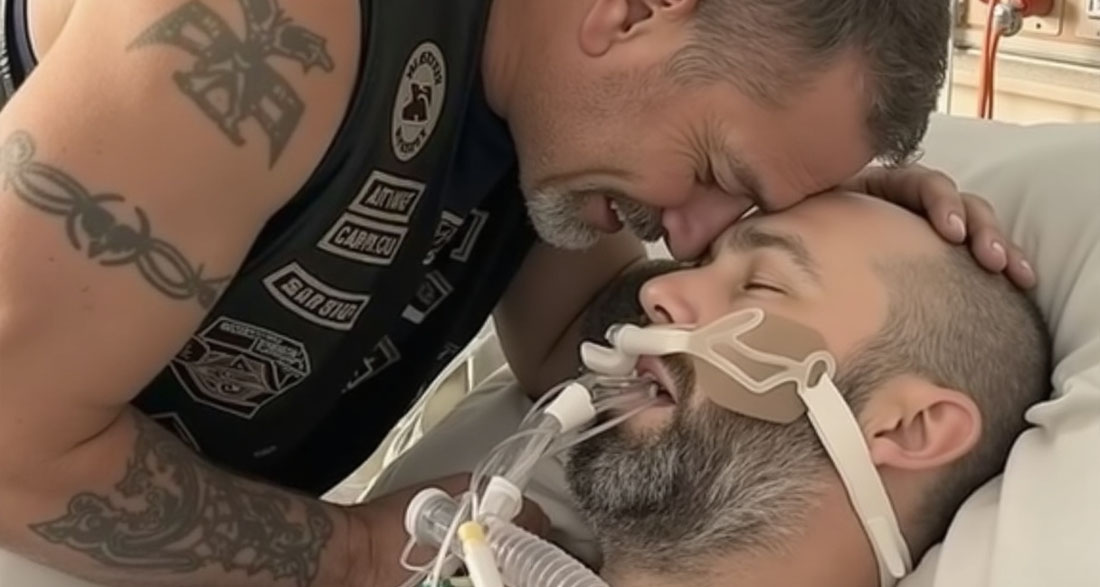
Now, standing beside his hospital bed, I stared at the same face that used to light up when he saw me. Machines hissed and beeped, tubes ran into his body, and bruises darkened his skin. I kissed his forehead, whispering his name, my voice shaking.
How had it come to this? The boy who used to cling to my back on long motorcycle rides—the boy who laughed so loud it made the wind itself seem to join in—had become a man ashamed to call me his father.
When his mother left, Tyler was only seven. She said I wasn’t fit to raise him. My rough edges, my bar fights, my freedom on the road, she said, made me the wrong kind of man for a family. Maybe she was right.
Or maybe she was just tired of a life that didn’t look perfect from the outside. She remarried a man in pressed shirts, a man who smiled like a TV anchor and drove a shiny black sedan. He was everything I wasn’t—polite, orderly, respectable.
Tyler slipped into that life like it had been waiting for him all along. That man became “Dad,” and I became “someone my mother used to date.”
The first time I heard him call that man Dad, I laughed. It was nervous, unsure laughter, because I didn’t know what else to do. The second time, I went home and punched a wall, my knuckles bleeding. The third time, I stopped showing up at all.
But I never stopped trying. Every birthday, every Christmas, I sent cards, small gifts, letters. Sometimes long letters, describing the rides I’d been on, the places I’d seen, telling him I was proud of the man he was becoming. I didn’t know if he read them.
Some came back unopened. Some never returned at all. Still, I hoped. I hoped he’d change his mind, that one day, he’d call.
Three weeks before the crash, I couldn’t bear the silence anymore. I found his office online and drove three hours. I sat in my truck, hands shaking, staring at the glass doors. Then I walked in.
There he was—my son—clean-shaven, wearing a crisp suit, standing taller than I remembered, successful, happy-looking. When he saw me, his smile vanished. His coworkers looked confused. He pulled me into a side room, away from prying eyes, and I said:
“I missed you. Can we talk? Grab a beer? Coffee?”
He stared at me like I was a stranger asking for money. Then he said it again, calmly, without a flicker of emotion:
“As far as I’m concerned, you’re dead.”
I nodded, pretending it didn’t hurt. I walked out before he could see the tears streaming down my face. I rode my bike until my eyes dried in the wind. That was the last time I saw him alive.
The call came late one night. His wife’s voice trembled.
“It’s Tyler,” she said. “There was an accident. You need to come.”
“How bad is it?” I asked.
She didn’t answer right away. “You need to hurry,” she said, her voice tight, trembling.
I rode through the night, the wind freezing my tears against my face. When I arrived, I found out he’d been hit by a drunk driver. He hadn’t woken since. When I gave my name, the nurse hesitated—records said I was dead. But his wife, Anna, told them to let me through.
She said quietly, “He’d want you here.”
Inside, I saw my son—my grown son—connected to machines I couldn’t even name. His chest rose and fell with mechanical breaths. His face was swollen and pale. I held his hand and whispered, breaking myself into the words:
“Hey, kiddo. It’s Dad.”
For a second, his eyelids twitched. Maybe wishful thinking—but I clung to that moment.
Days passed. I barely left his side. Anna was kind, bringing coffee, sitting quietly, telling me stories about the man he had become. Pictures of his kids—my grandchildren—covered the desk. I realized how much I had missed.
Then, one day, Anna came in holding a small box.
“I found this in his office,” she said.
Inside were every letter, every card, every photo I’d ever sent him. None had been thrown away, just hidden. My handwriting stared back at me from worn envelopes. Some unopened, some read and reread countless times.
She handed me her phone. On the screen was a photo of a handwritten letter, dated two weeks before the accident—from Tyler. He never sent it.
He wrote he’d been ashamed—not of me, but of himself. That he’d cared too much about what others thought.
That the man who taught him to ride, who gave him his first leather jacket, who loved him fiercely, was still part of him. He wrote he wanted to bring his kids to meet me, to show them where they came from.
The letter ended:
“I love you, Dad. I always did. I’m sorry it took me this long to say it.”
I sat there, holding his hand, reading and rereading, tears blurring the words. I told him I forgave him. I told him I loved him. I told him I never stopped.
On the third day, the doctors said there was nothing more they could do. I kissed his forehead one last time, whispered goodbye as they turned off the machines. That final breath—the one that was his alone—echoes in my mind. It was soft. Peaceful.
His funeral was in a church smelling of lilies and polished wood. The pews were filled with people who knew him as the polished man he had become, not the boy laughing on the back of my bike. I felt out of place—tattoos, leather, long gray hair.
But then I heard it—the rumble of engines. Fifty motorcycles lined the street outside. Brothers from the road, men who never judged me, who knew love and loss. They came for me. They came for Tyler.
When I spoke, I read the letter aloud. Every word resonated through that silent room. I wanted everyone to know the truth—that love never disappears.
Afterwards, the bikers circled me. One handed me a helmet. Without a word, we rode down the highway together. Wind on my face, I felt him there—the boy who once shouted, “Faster, Dad!”
Years have passed. His kids come over most weekends. They call me Grandpa.
I see Tyler in their laughter, in their fearless hands gripping handlebars, in their little sparks of adventure. They ask about their dad. I tell them stories—how he once fell asleep on my shoulder on long rides, how he tried building his own bike, how proud I was of him even when he thought I wasn’t watching.
They sometimes ask if he’s watching us now. I tell them I think he is. Every ride I take, every sunset, every small hand on the bike reminds me: the road between a father and son never truly ends. It bends, it breaks, it hurts—but it always finds its way back.
Somewhere out there, on a road I can’t yet reach, my boy is riding again—free, fearless, finally at peace.