


Sweet Grace Bakery was more than just a bakery. It was the last fragile thread connecting me to my daughter, Grace—the last place where her laughter still seemed to float in the warm smell of sugar and fresh bread.
I had named it after her because when she was little, she would perch on the kitchen counter, legs swinging, eyes shining. “Mom,” she’d say with complete certainty, “one day we’ll have a bakery together. I’ll decorate the cupcakes, and you’ll make the best bread in the universe.”
I used to chuckle at her bold claim. “The best bread in the universe? That’s a tall order, kiddo.”
She would just grin, confident as the sun. “Mom, you can do it. I know you can.”
Kids don’t worry about limits. They believe dreams happen simply because they want them to.
But leukemia doesn’t care about dreams. When she was six, my world darkened all at once. Hospitals became home. Medicine, needles, and tears I tried to hide filled every hour. Days blurred into nights, and grief became my shadow.
I would give anything to erase those memories, but grief doesn’t let go. What I clung to was her voice, her excitement, her dream of our bakery. At her bedside, as I held her tiny hand, I made a promise: I would build that bakery. I didn’t know how, didn’t know where the money or strength would come from—but I knew that if I let her dream die, it would feel like losing her all over again.
So, Sweet Grace Bakery was born—out of grief, stubbornness, and love. I worked twelve-hour days, sometimes longer. My hands cracked from kneading dough, sleep became a distant memory, and loans piled up like bricks in my chest. The first year was a struggle. The second year? Harder. Bills kept rising. And then came Marcus.
Marcus made it sound easy—fast cash, quick paperwork, a smile that didn’t reach his eyes. I knew he wasn’t a good man. I just didn’t know how dangerous he truly was. But when ovens failed and rent rose, desperation whispered that I had no choice.
And then came the night that changed everything.
I was closing up, flipping chairs onto tables, wiping the counters, telling myself that tomorrow might somehow be better—even though nothing felt like it would be. The street outside was silent, only my own breathing filling the stillness.
Then, the bell over the door chimed.
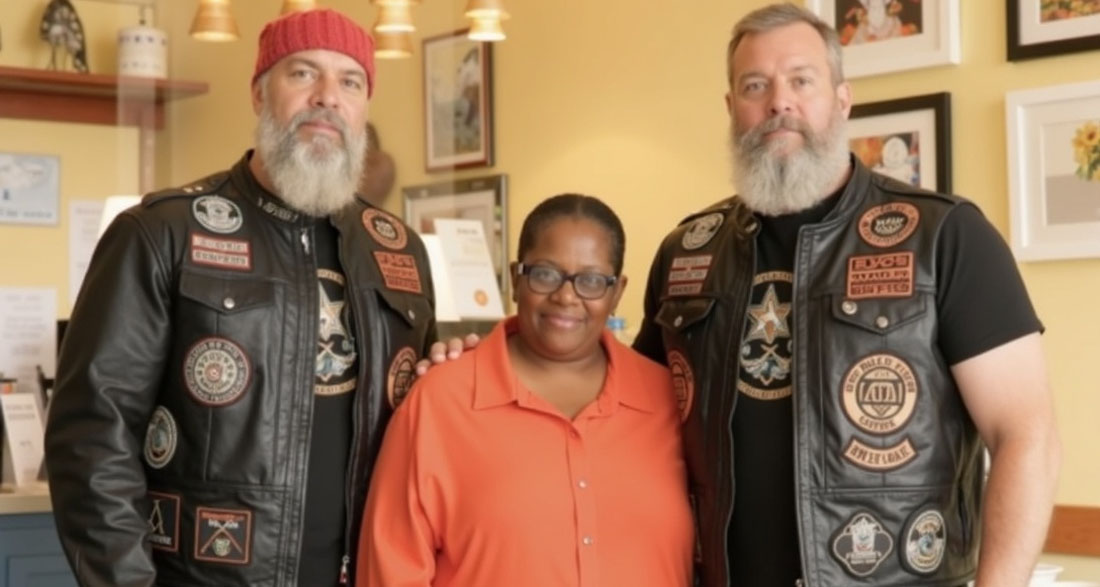
I looked up, expecting maybe a late customer. Instead, two enormous men stepped inside. Broad shoulders, shaved heads, leather vests covered in patches I didn’t recognize. One of them reached back and slid the lock into place—a soft click that felt like a gunshot in my chest.
“Bakery’s closed,” I managed, voice shaking despite my attempt at calm.
They didn’t answer. They just stared, dangerous, unyielding. The taller one stepped closer, and I felt the heat of his presence. “You know why we’re here,” he said quietly, low and rough. “The debt, sweetheart. It’s time.”
My heart thundered. Panic wrapped around my chest. Marcus had sent them. I’d heard the stories. People who didn’t pay on time… disappeared, or worse. I pictured them tearing down the bakery, taking everything Grace and I had worked for. I felt her slipping away again, and the thought hurt more than any blow could.
“I—I just need more time,” I whispered, backing into the counter. “Please. I’ll pay. I swear I will.”
The shorter man glanced at the taller one, some silent exchange passing between them. I braced for pain—but then, everything changed.
The taller man’s expression softened. He removed his sunglasses and tucked them into his vest. His eyes weren’t cruel—they were tired, heavy with something like sorrow.
“Ma’am,” he said gently, “we’re not here to collect anything.”
I blinked. “What?”
“We’re undercover,” the other man said, showing a worn badge. “Iron Brotherhood Motorcycle Club. We’ve been tracking Marcus for months. He was arrested earlier today. Every loan he gave out, including yours, was illegal.”
The room tilted. My hands gripped the counter to steady myself. “You mean… I don’t owe him anything?”
“Not another cent,” the taller man said. “You’re free.”
Relief crashed over me so hard it made my vision blur. But it wasn’t just relief—it was disbelief, confusion, and something like hope clawing its way back to life.
“I—I thought…” I started, then stopped. Words failed me.
The taller man nodded, as if reading my mind. “We get that a lot,” he said. “I’m Thomas.”
His voice carried honesty, a strange, unpolished truth. He told me about Marcus’s victims—single parents, struggling immigrants, anyone desperate enough to be trapped.
And then, he shared something I never expected: the story of his sister, Linda, lost to the same kind of loan trap. “My mom found her,” he said, voice cracking. “She’d written a note. Said she was sorry. Said she couldn’t see a way out.”
Tears pricked my eyes. “I’m so sorry.”
“I couldn’t save her,” he said. “But I can help people like her. People like you.”
The other biker unlocked the door. “You’re safe now,” he said. “Marcus won’t touch you again. No one will.”
After they left, I stood in the quiet bakery, letting it sink in. Leaning against the counter—Grace’s favorite spot—I whispered, “We’re okay, sweetheart. We’re really okay.”
I didn’t sleep that night. I stayed on the floor, hugging my knees, crying—tears of relief, release, exhaustion… and a fragile, budding joy.
The next morning, I unlocked the bakery at six a.m. Expecting a slow day. But at seven, a low rumble shook the street. Motorcycles. Dozens of them.
Faces appeared—Thomas, the other biker, and more, men and women of the Iron Brotherhood. They entered the bakery, laughter and smiles filling the space like sunlight.
“You open?” one of them asked, grinning.
“Y-yeah,” I stammered. “Of course.”
They ordered everything—pastries, pies, coffee, hot bread. Some ate in the shop. Some took boxes home. And when they paid, they didn’t haggle. They laid down bills with a generosity that made my heart thrum.
By noon, I had earned more than I usually made in a week. And the next day, more came. Week by week, the word spread. Sweet Grace Bakery was alive. Thriving. I no longer worried about bills or broken ovens.
They helped in other ways too—lawyers, repairs, grants. Within months, Sweet Grace Bakery wasn’t just surviving—it was flourishing. Every corner seemed brighter, every scent sweeter. I hung a picture of Grace near the register, and every biker who came in tapped it gently, a quiet greeting.
Eight months later, the Brotherhood invited me to their clubhouse. I baked a cake in Grace’s favorite colors—sky blue and soft pink, decorated with tiny butterflies she had loved chasing.
Forty bikers stood silent as I carried it to the center table. Rough, tattooed, scarred—they weren’t angels. But the way they honored my daughter’s memory, I saw grace in a form I had never known.
Thomas leaned beside me. “Helping you,” he whispered, “gave my pain a purpose. Linda would’ve wanted that.”
I touched his arm. “You saved me,” I said.
He shook his head. “You saved us right back.”
I looked around that room—people the world feared, yet filled with hope, loyalty, and kindness. I used to believe that night they came to the bakery would be the end.
I was wrong. It was the night everything began.