
For as long as I can remember, my name felt like a coat that never fit right. Too tight across the shoulders. Too heavy in ways I didn’t understand. Before anyone even asked me what I liked, what I dreamed about, they already thought they knew me.
I was “the garbage collector’s son.” Not the name my mom whispered when she kissed me at night. Not the one that felt warm and mine.
No, this name followed me everywhere—in the hallways, the lunchroom, in the way teachers hesitated just a little before calling on me. Like a shadow I couldn’t shake, no matter how fast I ran.
At first, I didn’t even know what it meant. I just knew it came with a look, a polite little smile that didn’t reach the eyes, a distance that felt colder than open dislike. Other kids talked about their parents’ jobs like they were trophies.
“My dad’s a lawyer!” “My aunt’s a doctor!” They said it loud and proud, like it gave them extra space in the world. When someone asked about my parents, I learned to answer quickly and change the subject.
“My mom works for the city,” I’d say, then ask about their dog, or their new shoes, or the homework—anything to move the spotlight away from me.
My mother hadn’t planned this life. She used to tell me stories about nursing school—the long nights studying, the antiseptic smell, the endless coffee in the hospital corridors. She loved helping people, easing their pain.
Then my father fell. It was an accident, stupid and ordinary, the kind you see in the news for a day and then forget. One minute he was alive, joking about dinner, and the next he was gone. Grief didn’t tiptoe in. It slammed into us like a wave, washing away dreams, plans, the feeling that the world was safe.
My mom took the first job that would pay the bills. Every day before sunrise, she tied her hair back, pulled on gloves, and stepped into a world smelling of diesel, waste, and hard work.
She came home exhausted, shoulders aching, hands rough as sandpaper, but still she cooked dinner, asked about school, and listened when I talked about the tiny things that didn’t matter. I learned to lie softly. “It was fine,” I’d say. “Nothing special.” I didn’t want to add my small hurts to the mountain of hers.
School was no easier. The teasing wasn’t always loud. It was quiet, sharp, like tiny cuts you didn’t notice until they stung. A wrinkle of the nose when I walked by, a note on my desk with a stick figure in a trash can.
The laughter was soft enough that teachers rarely caught it. I learned the art of disappearing. I sat at the back. I didn’t raise my hand. I became an expert at being there without being seen.
The library became my sanctuary. Cool, quiet, safe. Books didn’t judge me. Numbers didn’t care about my last name. I buried myself in old math textbooks, online lessons, anything I could find. Problems had answers. Life didn’t always. That fairness became addictive.
Algebra turned into calculus. Calculus into subjects I didn’t even know the names of. I didn’t fully understand why I loved it. I just knew that when I solved a problem, the rest of the world disappeared. The laughter, the looks, the labels—they all faded.
One day, Mr. Anderson, my thin math teacher with kind eyes and a habit of pushing up his glasses, noticed. Instead of telling me to slow down, he asked, “What do you want to learn next?” No one had ever asked me that.
He handed me books, links, problems harder than anything I’d tried before. For the first time, someone treated me like I had a future, not like I was just a kid defined by my father’s job.
With him, college stopped being a dream for someone else. It became something possible. We dug through programs, scholarships, applications that felt like another language. Fees that seemed impossible until we found waivers. Essays that forced me to put into words things I’d never spoken aloud.
Writing those essays hurt more than any math problem. I had to talk about my life, my mom, the way I felt both invisible and seen. I cried over my laptop late at night while she slept, exhausted. I didn’t want her to hear me. I didn’t want her to think she’d failed me.
Then the letter arrived. Heavy, official, more than it should have been. My hands shook as I held it. When I finally opened it, the words blurred at first: full scholarship, housing, acceptance. A future I’d only imagined quietly, alone, became real.
Mom cried when I told her. Not soft tears, but loud, shaking sobs. “I am so proud of you,” she kept saying. Over and over. As if saying it could make it real.
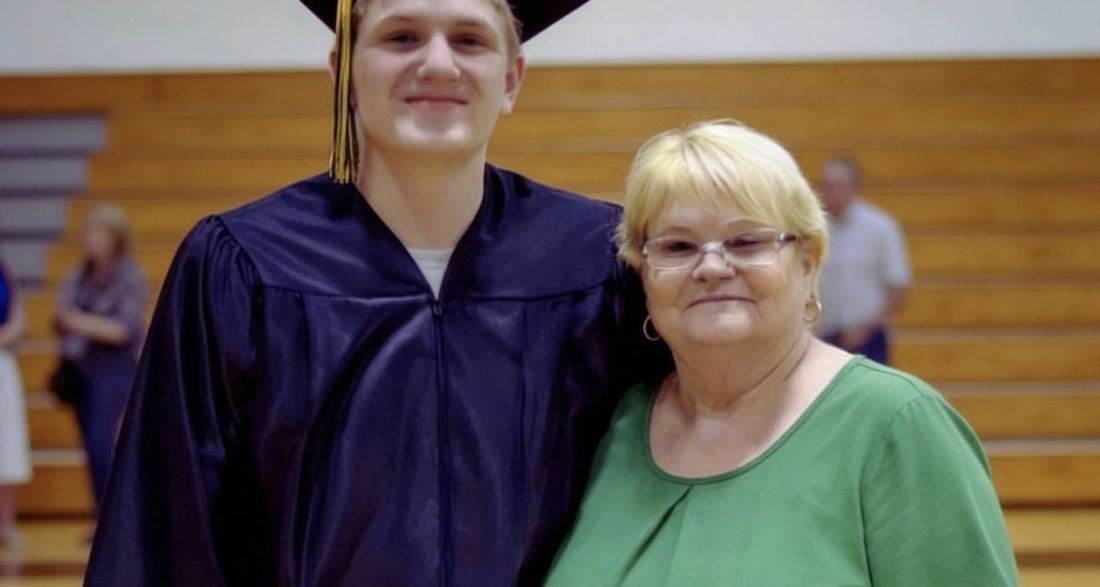
Graduation came faster than expected. The gym buzzed with families, balloons, cameras, the mix of flowers and sweat and excitement. When they called my name as valedictorian, I felt my body lift from me, walking out of myself. I stood at the podium, looking at faces that only knew pieces of me.
And I spoke.
I spoke about the jokes, the labels, my mother’s uniform and her strength. About how easy it is to decide who someone is before you even look. About dignity—not given or taken by a job, but something you carry yourself.
The room was quiet in a way I’d never known. The applause felt distant, underwater almost. The only real thing was my mother’s face, shining with tears, joy, relief, and pride all at once.
That night, she came home from work. Her uniform still smelled the same, but it didn’t feel heavy. It smelled like proof—proof of strength, of love, of resilience. I held onto that feeling, letting it fill the spaces that used to be empty. And for the first time, I didn’t feel like a name that didn’t fit. I felt like myself.