


The call came just after three in the morning. My phone buzzed against the nightstand, sharp and insistent, cutting through the fog of sleep. I answered, and a tired, almost broken voice whispered, “Please… come quick.” It wasn’t the usual urgency firefighters carry.
These are men who rush into burning homes without hesitation, men who lift fallen beams off strangers, men who don’t flinch at screams or smoke. But this voice… it trembled in a way that made my stomach twist. “There’s a five-year-old,” they said, “and he won’t stop screaming that he killed his mommy. Nothing we’ve tried works.”
Rain poured as I drove, cold and steady, drumming on my leather vest as I ran toward the house. The flashing lights painted the wet streets red and blue, reflecting off the faces of the firefighters gathered outside.
They had battled the fire, dragged hoses through choking smoke, carried out what had to be carried out. But now they were still. Red-eyed. Hands shaking. Not from the flames. From the boy.
Inside, the kitchen was blackened, the smell of wet ash thick in the air. In a shadowed corner, behind a scorched table leg, sat Marcus. He was so small I had to blink twice, as if he might vanish.
His little body shook in violent bursts, like he couldn’t control his own bones. His pajamas clung to him, soaked with tears and smoke. His voice, thin and cracking, repeated the same terrible words over and over: “I killed my mommy. I killed my mommy.”
And in that moment, I understood. When the fire started, his mother had shoved him toward the back door. “Go! Call 911!” she had screamed. He obeyed. And in his tiny mind, obeying meant leaving her behind, choosing himself over her, surviving while she didn’t.
He didn’t know her choice had been the selfless, protective kind a mother makes without thinking—and that choice had saved his life.
Two firefighters tried to reach him, softly coaxing. He curled tighter into himself, shaking harder. I knew if I tried to touch him, he’d pull away, scream louder. So I didn’t move. I sank to the floor a few feet away, my back against the melted cabinet. I spoke as gently as I could. “I’m not here to take you anywhere,” I said. “I’m just going to sit here. As long as you need.”
For what felt like forever, he didn’t even look at me. He cried into his knees, the kind of crying that sounds like it’s tearing something inside. But slowly, almost imperceptibly, the storm in him softened. His sobs became shorter, quieter.
Finally, he lifted his head. His eyes met mine—huge, frightened, confused… and just a hint of hope. The hope that maybe someone could tell him he wasn’t the monster he thought he was.
So I told him a story. A story I rarely let myself speak aloud. I told him about the night my own house burned when I was eight. How my father had shoved me out a window when smoke filled the rooms. How he told me to run, to get help, and how I obeyed.
And how the roof collapsed before my father and baby sister could escape. I told him how, for years, I carried the belief that I had killed them. How every time someone said it wasn’t my fault, I nodded, but inside… I never believed a word.
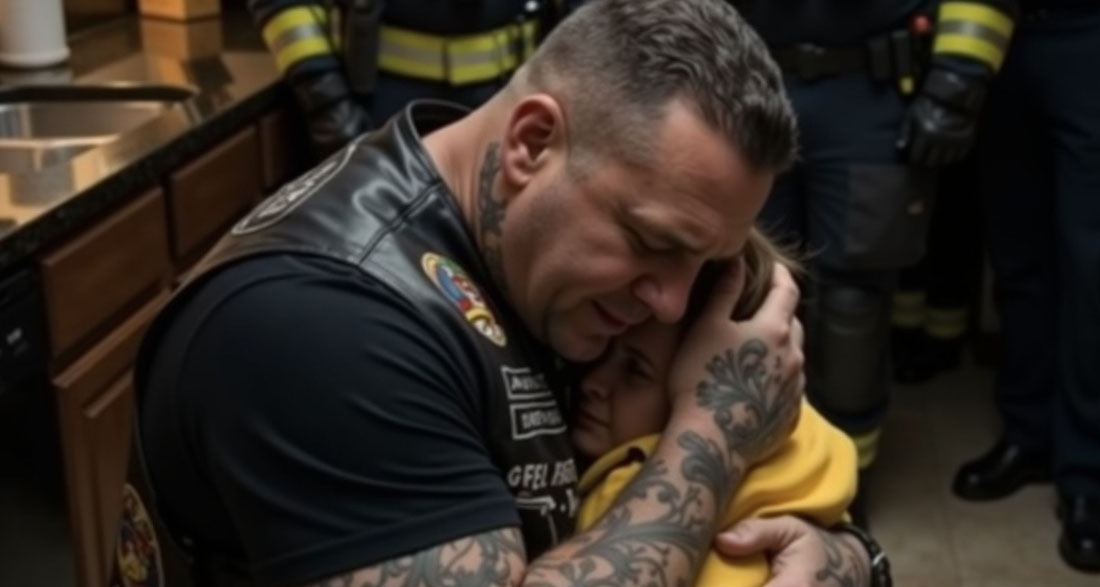
While I spoke, Marcus froze. His crying slowed to shaky breaths. The room felt heavy, like everyone was holding it in with him. And then, suddenly, he launched himself across the floor and into my arms. Desperate. Afraid I’d disappear if he hesitated.
I wrapped him in my vest, holding him close, rocking gently. Firefighters stood silently, tears streaking their soot-streaked faces. Marcus whispered over and over, “I want my mommy.”
And all I could give him were my arms and the truth: that his mother had loved him enough to save him, that her last thoughts were of him, her boy, running to safety.
By sunrise, the fire was out, the rain had stopped, and child services arrived. A social worker knelt beside us, her voice soft, gentle. Marcus clutched my hand tighter, burying his face against my shoulder. “Please… don’t leave me,” he begged.
She looked at him, then at me, and saw what I hadn’t fully realized yet—he trusted me. She nodded, allowing me to stay with him during the transition.
Over the next days, I never left his side. I sat through check-ups, held his hand when nightmares woke him, listened as he tried to speak through tears. It reminded me of my own childhood grief—years I had spent alone, wishing someone had sat with me the way I sat with him.
When his grandmother arrived—a weary woman with gentle hands and eyes full of history—Marcus clung to her, but he never let go of me completely. “Thank you,” she whispered, her voice shaky, and took him home. I thought that was the end.
But it wasn’t. Something in me refused to walk away. Maybe it was the memory of my father’s voice. Maybe the echo of my sister’s laugh. Or maybe it was Marcus, small and tear-streaked, who had wrapped himself around me like I was the only solid thing left in his world.
So now, every month, I drive hours to see him. His grandmother sets out a chair for me in the backyard under the big tree with uneven branches. Marcus runs to me—not with the fear of that first night, but with a growing, confident smile.
We sit on the grass or the picnic table, talking about school, nightmares, guilt—the kind that beats in your chest like a second heart. I tell him what I wish someone had told me when I was eight: that being a child doesn’t mean carrying impossible blame.
That love can push you out a door or window to give you a chance. That surviving doesn’t mean you caused the loss.
Slowly, the weight on his tiny shoulders lifts. He laughs now—real laughter, bubbling from the center of him. He’s learning the truth: he didn’t cause his mother’s death. She saved him. And in teaching him that, he taught me too.
Last month, as we tossed a ball back and forth, he stopped mid-throw and looked at me seriously. “Can I call you Uncle Danny?” he asked. The words hit me like a punch I didn’t see coming. I nodded, speechless.
In that moment, I realized something profound. I hadn’t just helped a broken child. He had helped me. All those years I blamed myself for the fire, Marcus helped me see it through different eyes. Sitting with him, month after month, talking through fear, love, and loss, I faced my own pain in ways I had avoided for decades.
Healing doesn’t always move in a straight line. Sometimes it’s quiet. Sometimes slow. Sometimes it’s two people sitting under a backyard tree, hands touching, hearts opening. Sometimes the one who comforts is also the one being healed.
I went there to save a boy who believed he had caused the unthinkable. But in the end, Marcus saved me too. He proved that love, loss, and healing can move in a circle, finding the broken pieces you thought could never mend.
Now, every time he says, “Uncle Danny,” something inside me settles—a part that had been restless for decades. That night in the burned-out kitchen, I didn’t just save him. He saved me.