


I had been running Maggie’s Diner for over thirty years. Thirty years of knowing people before they even opened their mouths. I’d seen everything—drifters searching for a meal, families arguing over ketchup, truckers half-asleep over their coffee, and the occasional drunk who thought a stack of pancakes could sober him up. I thought I’d seen it all.
But nothing prepared me for fifteen bikers rolling in on a late Tuesday night. Boots scuffed from miles of asphalt, jackets smelling of gasoline, faces hidden behind dark glasses.
My gut tightened—not fear exactly, but that sharp, protective instinct you develop after building something with your own hands and losing someone who shared it with you. The neon clock above the counter glared 10:15.
The roads outside were empty, silent except for the hum of the fridge and the quiet whoosh of the air conditioner. It was just me and my young waitress, Amy, who was folding napkins at the counter, trying not to fidget.
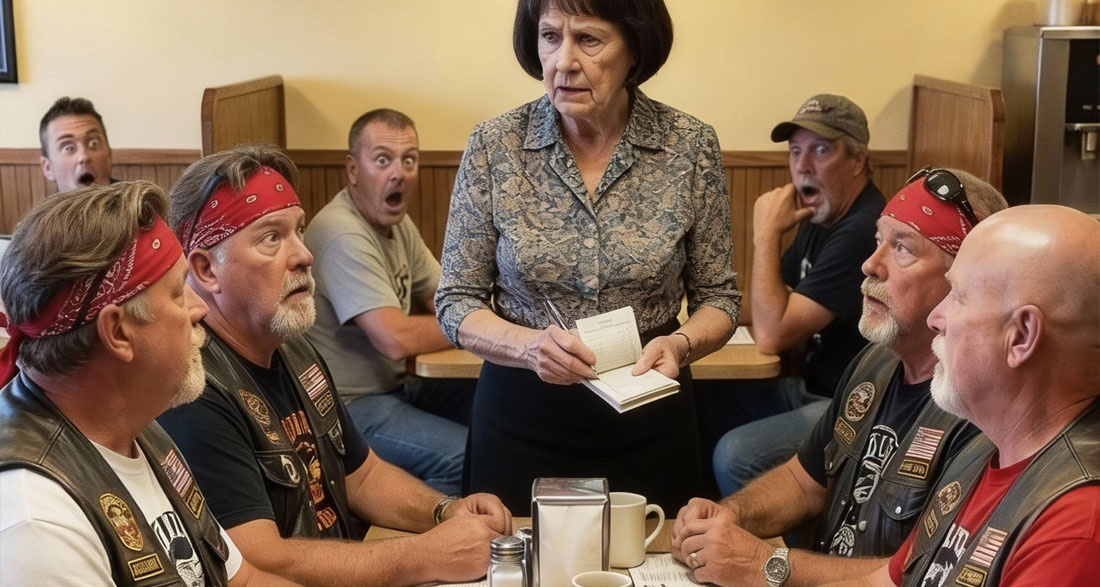
They stormed in like a pack, leather and chains rattling, each one a wall of muscle and attitude. I saw trouble in an instant—not the kind that smashes windows, but the kind that makes you second-guess your every move. My hand tightened on the coffee pot. “You boys can eat,” I said, my voice sharper than I meant. “But you pay before I serve.”
The silence that followed felt endless. Then the biggest one—gray hair slicked back, a streaked white beard, shoulders broad as a doorway—nodded. Calmly. He reached into his pocket, pulled out a thick roll of cash, and set it on the counter.
“No problem, ma’am,” he said. “We understand.” His voice was steady, respectful. Even polite. He gave me a small nod of thanks.
I forced a tight smile. “Right,” I muttered to myself, walking back to the kitchen. Fear and caution had become unwelcome companions since my husband, Tom, died. Still, shame burned quietly in my chest. I tried to tell myself it was just being careful.
They moved to the back of the diner, away from the windows, and ordered like normal folks—burgers, eggs, pie, and more coffee than a heart should handle. Amy took their orders with trembling hands, but they were gentle with her.
“Thank you, sweetheart,” one said, smiling warmly. Another asked about the pie. “Apple,” Amy told him, and his face softened, like the word brought him comfort. They talked quietly among themselves, voices low, measured, like men who had shared decades of hardship together.
When they finished, they cleared their plates, wiped the table, and left as quietly as they had arrived. No shouting, no rowdy laughter, no broken glass—just the soft jingle of the door and the rumble of motorcycles fading into the night. Relief washed over me, followed by guilt. I’d judged them before they’d even said a word.
Then Amy’s voice shook me out of my thoughts.
“Maggie?”
I hurried over, expecting maybe a wallet or jacket they’d left behind. But on the empty table sat an envelope, neatly addressed: “Maggie.” No last name, no return address.
Inside was a handful of cash—far more than their bill—and a folded note. The handwriting was precise, deliberate, the kind that carried weight.
“Ma’am,” it began, “we’re sorry if we made you uncomfortable. We’re veterans—all of us. We were riding home from a funeral for one of our brothers. We stopped because we saw the American flag in your window. We figured a place that flies that flag might feel like home, at least for a cup of coffee.”
My throat tightened.
“We understand why you asked us to pay first. The world makes it hard to trust people. But we wanted you to know who we are beneath the leather. Men who served. Men who’ve lost more than most can understand.
We noticed the picture behind your counter—the man in uniform. We can tell he mattered to you. If he served, we owe him our thanks. And if he was yours, then we owe you our respect. You may not have trusted us tonight, but please know—we would’ve protected you with our lives if we had to. That’s who we are.”
I sat down at the table, the diner silent except for the soft hum of neon outside, and I cried. Not the polite kind, tucked behind a napkin, but the kind that comes from deep inside—the place where grief, fear, and gratitude all collide.
I had been so sure of my instincts. So certain they had never failed me. And yet, that letter showed me something my instincts had missed: grace.
I thought about Tom—how he used to walk into this diner in his uniform when he was home on leave. How proud he looked in that framed photo behind the counter, standing tall, eyes full of hope. He had died years ago, but somehow, those bikers had seen him. And they had seen me, even when I was too busy guarding myself to see them.
The next morning, I couldn’t shake it. I stared at the flag in the window, wondering if that’s what had drawn them in, or maybe it was fate, sending me a reminder that not everyone who looks rough is dangerous. I wanted to find them, to tell them thank you, and to apologize for my suspicion.
A week later, they came back—same quiet respect, same group. This time, I didn’t make them pay first. I poured coffee, smiled, and said, “The pie’s on the house tonight.”
The gray-haired one smiled. “We were hoping you’d say that,” he said.
I told them I had read the note. My voice shook, but I managed, “I’m sorry.”
He nodded, eyes warm. “You don’t owe us that. You were doing what you thought you had to do. That’s what people like us understand.”
That night, they stayed longer. They talked about their rides, their losses, and the brother they had buried. “Doc,” they called him. He had patched them up overseas, kept them alive. His funeral had been the reason for their journey home.
I told them about Tom, about the Army sending me a folded flag and a letter. Ray—the gray-haired man—nodded slowly.
“He’d be proud of you, Maggie,” he said. “You kept his spirit alive right here.”
From then on, things changed. They came often, always respectful, helping out when I needed it. They fixed the leaky roof, painted the back door, built a new sign. When my knees ached or my hands grew tired, they checked in. Ray shoveled snow. Hank, quiet and gentle, brought my grandson a baseball glove. “Every kid needs to learn how to catch,” he said.
The diner became more than a place to eat. It became a refuge. They brought new veterans, introducing them like family. “This is Maggie,” they’d say. “She makes the best pie you’ll ever eat.”
Word spread. Townspeople who used to fear bikers began to see them differently. I’d be asked, “Aren’t you scared having so many of them around?” I’d smile and say, “Those men? They’re the safest thing that ever happened to this diner.”
Years passed. Some left, some grew too old to ride, some were lost. But Ray—steady as ever—still stopped by monthly, swapping his Harley for a pickup. He’d sit at the counter, sip coffee, and ask, “You still keeping that envelope?”
I always nodded. It stayed in the drawer under the register, cash untouched, letter folded neatly on top. Not for the money, but for the reminder—the night I almost let fear decide for me, and the men who refused to let it.
One rainy evening, I closed early. The diner silent, rain tapping on the windows, I read the note again. Yellowed paper, fading ink, but still full of weight. I thought about all the times I’d judged someone too soon.
Experience can make you wise—or cautious, even cynical. You see enough bad moments, and you start expecting more. But that night reminded me: goodness can wear any face, even one you don’t trust at first glance.
Now, every time a stranger walks in, I remind myself to look beyond the surface. Maybe they’re tired. Maybe they’ve lost someone. Maybe they just need a warm meal and a kind word. I can give them that.
The diner still stands. The walls now lined with photos—Tom in uniform, the veterans on their bikes, my grandson with Ray, both grinning ear to ear. The flag still waves in the window.
Sometimes, I hear motorcycles in the distance. I step outside, hoping it’s them. The rumble fades, but the memory never does. They didn’t just pay for their food—they gave me something I thought I’d lost: trust.
I once made them pay first because I didn’t trust what I saw. They repaid me with loyalty and compassion that lasted years. They showed me fear can blind you, but humility opens your eyes. Character isn’t worn on the outside—it’s carried in the heart.
And when the diner’s empty, the neon humming softly, I whisper a quiet thank-you—to my husband, to those men, to the lesson that keeps my heart warm all these years.