


Twenty years ago, December took everything from me.
It took my baby.
And then, a week later, it took my husband too.
What it left behind was silence—thick, heavy silence that filled every corner of my house and pressed against my chest until breathing felt like work.
It has been two decades, but I still remember that December as if it never really ended.
No baby cries echoed through my home.
No soft lullabies hummed in the evenings.
Just the loud, cruel ticking of the kitchen clock, counting seconds in a world that no longer felt like mine.
I was five months pregnant when I lost my baby.
No warning.
No pain beforehand.
No final kicks to say goodbye.
I was five months pregnant when I lost my baby—one moment dreaming about names and nursery colors, the next lying under harsh fluorescent hospital lights while a doctor spoke in a gentle voice that couldn’t soften the words.
“I’m so sorry,” he said quietly. “There’s no heartbeat.”
After that, everything blurred together.
A hospital room that smelled like disinfectant.
A nurse placing a hand on my shoulder.
Paperwork I didn’t remember signing.
And then I came home… to an empty crib.
The nursery stayed exactly how we’d left it.
Yellow walls we had painted together.
Tiny onesies folded neatly in drawers.
Stuffed animals arranged on the rocking chair just a week earlier.
At night, I would stand there, holding a soft onesie against my chest, whispering apologies to a baby who would never hear them.
The crib stayed empty.
A week later, my husband packed a suitcase.
At first, I thought maybe he just needed space. Maybe he’d stay with his brother for a few days. Maybe grief had scared him the way it had broken me.
But he wouldn’t look at my face.
He stared at the floor and said the words that finished me.
“I need a family,” he said quietly. “And I don’t see one here anymore.”
Doctors had already told me the truth by then.
The damage was too severe.
My body wouldn’t carry another pregnancy.
There would be no second chance.
“The damage is permanent,” the doctor had said gently.
Three days later, my husband filed for divorce.
He said he wanted children.
Real children.
And just like that, he was gone too.
No one came for Christmas that year.
I stopped answering messages.
Stopped returning calls.
Some days, I forced myself to eat a piece of toast just so I’d have enough energy to cry.
In the shower, I turned the water on full blast so the neighbors wouldn’t hear me sobbing.
Grief didn’t care how long I cried. It settled into my bones and stayed.
A few days before Christmas, I realized I hadn’t left the house in over a week.
There was no tea.
No milk.
No bread.
I didn’t even want food. I just wanted something warm to hold.
So I bundled myself in a coat and walked to the corner grocery store.
Christmas music blasted through the speakers.
People filled the aisles with laughter, wrapping paper, trays of cookies, bottles of wine.
Everyone glowed with holiday joy.
I stood in line holding a cheap box of tea, staring at the floor, trying not to cry in public.
That’s when I heard a small voice behind me.
“Mommy, do you think Santa will bring me a doll this year? And candy too?”
I turned slightly.
The little girl couldn’t have been older than five.
Her hair was pulled into a crooked ponytail.
A small scar crossed one cheek.
She clung tightly to her mother’s coat, like it was the safest place in the world.
Their shopping cart held only milk and bread.
The mother knelt down and brushed her daughter’s hair back, tears filling her eyes.
“Oh, sweetheart,” she whispered. “Santa wrote me a letter. He said he ran out of money this year.”
The little girl’s face fell.
But she didn’t cry.
She just nodded, like she already understood disappointment.
Something cracked open inside me.
I don’t remember deciding. I just moved.
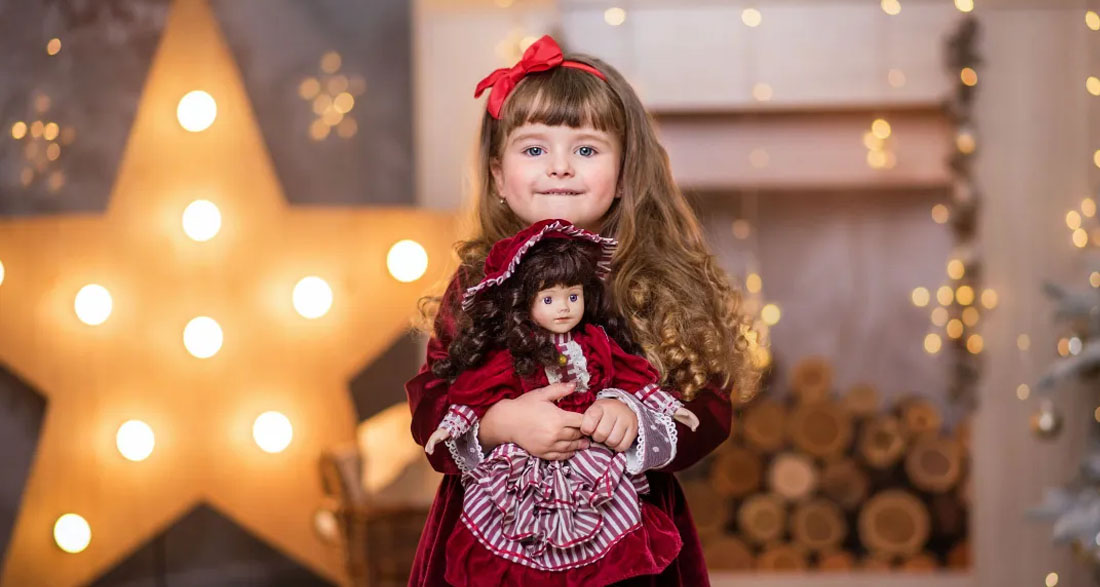
I left my tea on the counter and ran down the toy aisle, my heart pounding so hard I could hear it in my ears. I grabbed the last doll on the shelf, candy canes, a small teddy bear, an apple, and an orange.
When I rushed back, they were gone.
I paid quickly, stuffed the receipt into my purse, and ran into the parking lot. They were just crossing the street.
“Hi!” I called out, breathless.
The mother turned, startled. The little girl stared at me with wide eyes.
I knelt on the cold pavement and smiled.
“I’m one of Santa’s elves,” I said. “We dress like regular people so no one knows.”
The girl’s eyes grew even wider as I handed her the bags.
“Santa broke his piggy bank,” I whispered. “But he asked me to bring this to you. He said you’ve been very, very good this year.”
She screamed with joy and threw her arms around my neck so tightly I nearly fell over.
Her mother covered her mouth, tears spilling down her face.
“Thank you,” she whispered. Just that. Nothing more.
And for the first time in weeks, I could breathe.
It was the smallest thing I’d ever done.
But it saved me that night.
Years passed.
Twenty of them.
I never had another child. The doctors were right.
I tried dating, but nothing ever lasted. Men either left too soon or stayed without ever really seeing me.
I filled my days with books, quiet evenings, and part-time work that paid the bills but never filled the emptiness.
Christmas became quieter each year.
A small tree, if I remembered.
One gift for myself.
A glass of wine, if I felt brave.
But that little girl never left my thoughts.
Every December, I wondered if she still had the doll. If she remembered the strange woman who pretended to be Santa’s elf.
Then, one Christmas Eve, as I sat alone at my table with one plate and a flickering candle, there was a knock at the door.
I wasn’t expecting anyone. Not even the mail.
I opened the door and stopped breathing.
A young woman stood there, maybe twenty-five, wearing a red coat. The scar on her cheek was faint, but my heart recognized her instantly.
“I don’t know if you remember me,” she said softly. “But I remember you.”
“Oh my God,” I whispered. “It’s… you.”
She smiled. “I still have this scar. I got it falling off a tricycle when I was four.”
I wiped my eyes. “How did you find me?”
“You’ll see,” she said gently. “Please come with me. There’s something I want to show you.”
We drove for forty-five minutes. Soft carols played. My thoughts raced.
“You remember that day?” I asked.
“I remember everything,” she said. “So does my mom.”
We arrived at a beautiful house wrapped in lights.
Upstairs, her mother lay in bed, thin and tired, but her eyes lit up when she saw me.
“You saved us,” she whispered, gripping my hand. “I was broke. Her father had just died. That Christmas, I had nothing.”
She smiled weakly. “But you reminded me kindness still exists.”
She explained how that night inspired her to start making dolls at home. How it grew into a business.
Then she said the words that changed everything.
“I’m dying,” she said softly. “But before I go, I want you to be part of our family. Please… don’t spend another Christmas alone.”
I broke down crying.
They meant it.
Mia held my hand and whispered, “You gave me the only gift that ever mattered. Now it’s our turn.”
Her mother passed away two weeks later.
At her funeral, I saw what kindness had built—a legacy of love.
Twenty years ago, I thought my life was over.
I was wrong.
Sometimes the smallest act of love comes back to you as a second chance… disguised as a knock on the door.